The Bones of Your Dream Home: A Guide to Stronger Spaces
If you are reading this, you are likely dreaming of a new kitchen with a massive island, a great room where your kids can run around, or a quiet master suite that feels like a sanctuary. One of the most important choices we make is between Laminated Veneer Lumber, or LVL, and traditional sawn lumber.
Why Your Framing Material Matters in East Tennessee
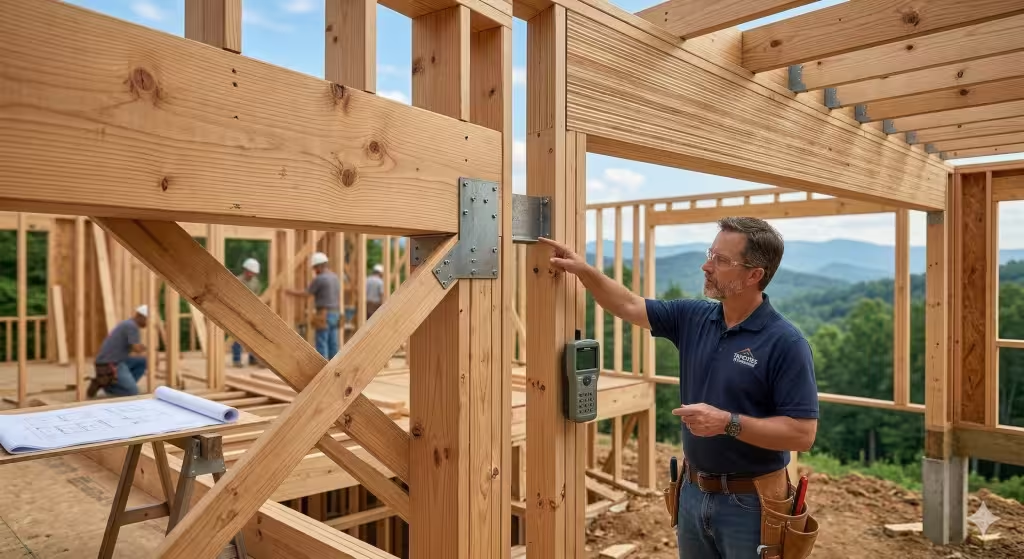
When you are looking at a map of the Tri-Cities, you see a beautiful patchwork of mountains, river valleys, and rolling hills. This is to say that a house here is not just sitting on a flat piece of dirt. It is part of a living, breathing environment that presents some very specific challenges to the wood we use. Whether we choose sawn lumber or an engineered beam, that choice affects how your home handles our unique East Tennessee climate over the next several decades.
The Terrain of the Tri-Cities
In our area, we deal with a lot of varying topography. You might be building on a steep ridge in Johnson City or near the flatter basin of the Holston River in Kingsport. When a house is built on a slope, the foundation and the framing have to work much harder. The gravity pulling on a house built on a hill means the “bones” need to be incredibly stiff. If we use sawn lumber for a large floor system on a sloped lot, we have to be very careful about how that wood is supported.
Sawn lumber is a wonderful material, but because it is a single piece of a tree, it can be prone to “creep” over time. Creep is a fancy engineering word that just means the wood starts to sag under its own weight or the weight of your furniture. In our hilly terrain, any tiny bit of sag in a floor made of sawn lumber can feel much worse because the house is already dealing with the natural angles of the land. Using high-quality sawn lumber is essential, but knowing when to switch to an engineered beam is what keeps a mountain home feeling level and solid.
Dealing with Appalachian Humidity
One of the biggest factors we face here is our humidity. If you have ever spent a July afternoon in the Tri-Cities, you know exactly how thick the air can feel. Wood is like a sponge. Sawn lumber especially loves to breathe along with the environment. When the humidity is high, sawn lumber absorbs moisture from the air and swells up. When we turn on our heaters in the winter and the air gets dry, that same sawn lumber shrinks back down.
This constant “breathing” is why you might hear your house “pop” or “groan” at night. It is also why many older homes in our area have doors that stick in the summer but swing easily in the winter. When we use traditional sawn lumber for the main structure of a home, we have to account for this movement. If a builder does not understand how sawn lumber reacts to the East Tennessee dampness, you might end up with wavy walls or cracked tile in your beautiful new kitchen.
Engineering for Precision and Integrity
When we use sawn lumber, we are working with a natural product that has a bit of “personality.” No two pieces of sawn lumber are exactly the same. One might have a slight curve, which we call a “crown,” while another might have a small twist.
In a custom home, we want everything to be as square and level as possible. If we are building a large, open room, the precision of the materials becomes even more important. Sawn lumber can be graded for strength, but it will never be as perfectly straight as a manufactured beam. My goal is always to use sawn lumber where it makes sense—like in the walls—and use engineered wood where we need that absolute, mathematical precision to keep your ceilings flat and your floors quiet.
The “Open Concept” Dream in Tennessee
Many of the families I work with in the Tri-Cities want those big, open floor plans. They want to be able to stand in the kitchen and see the kids playing in the living room. To make that happen, we often have to remove walls that would normally hold up the second floor. This creates a “span” that the wood has to cover.
Standard sawn lumber is limited by the size of the trees in the forest. It is very hard to find a piece of sawn lumber that is long enough and strong enough to cross a twenty-foot room without a support post in the middle. If we try to use multiple pieces of sawn lumber bolted together, it can get very heavy and bulky. This is why I often advocate for a mix of materials. We use sawn lumber for the parts of the house that don’t have to work as hard, and we save the heavy lifting for materials that can handle the stress of a modern, open design.
Building for the Long Haul
We also want to think about how the house will look and feel twenty years from now. We want you to be able to walk across your floor without a single squeak. I want your crown molding to stay tight against the ceiling without gaps appearing. A lot of those “settling” issues people talk about are actually just the sawn lumber in the frame drying out and shrinking.
By being very intentional about where we use sawn lumber and where we use engineered wood, we can minimize those problems. Sawn lumber is the heart of the American home, and it has served us well for a long time. However, in our humid, hilly East Tennessee environment, we have to be smarter about how we use it. We have to respect the natural properties of sawn lumber while using modern engineering to fill in the gaps where nature might fall a little short.
Why I Love the “Bones” of a House
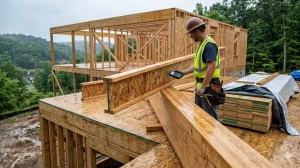
There is something very satisfying about seeing a house before the drywall goes up. You can see the skeleton of the home. You can see the rows of sawn lumber standing tall, forming the walls. You can see the massive beams overhead holding everything together. It is a work of art, but it is also a work of science.
We take a lot of pride in making sure that every piece of sawn lumber is installed correctly. We make sure the “crown” of the wood is facing up so that as the house settles, the floor becomes level rather than dipping. It is that kind of attention to detail that separates a “house” from a “custom home.” Whether we are talking about the studs in your walls or the headers over your windows, the quality of the sawn lumber we choose reflects the quality of the entire project.
Technical Integrity in the Tri-Cities
We are a community that values hard work and doing things the right way. We want you to feel competent and informed when you talk to your builder or your architect. Knowing the difference between how sawn lumber and LVL handle our local weather gives you the power to make the best decisions for your family.
Every piece of sawn lumber has a story. It grew in a forest, it was harvested, and it was cut to size to help build your dream. My job is to make sure that story has a happy ending. By combining the natural strength of sawn lumber with the precision of modern engineering, we can create a home that is not just beautiful to look at, but strong enough to handle everything East Tennessee throws at it.
Understanding the Basics: Veneers vs. Sawn Timber
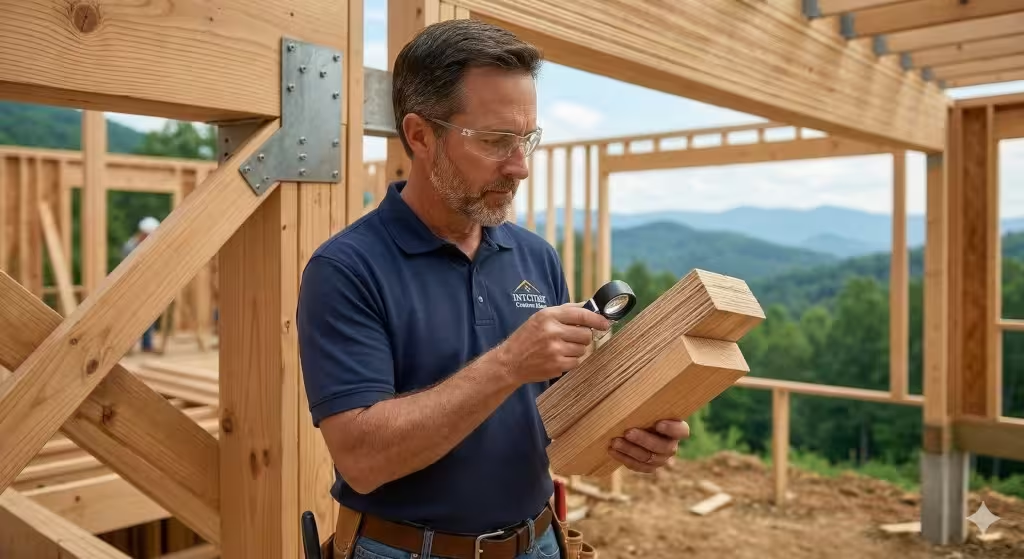
Understanding where your wood comes from helps you to know how it will behave in your home for the next fifty years.
In our part of the country, we are surrounded by beautiful forests, and the tradition of using sawn lumber is deep in our roots. But the technology behind LVL is truly fascinating when you see how it solves the natural “problems” that come with a tree.
The Life of Sawn Lumber
When we talk about sawn lumber, we are talking about a product that is very close to nature. At a sawmill, a log is placed on a carriage and run through a large saw. The goal is to get the most usable wood out of that single log. If you are building a home in Johnson City or Kingsport, the sawn lumber arriving on your job site was once a standing tree, likely a Douglas Fir or a Hemlock.
Because sawn lumber is one solid piece of wood, its strength depends entirely on that specific tree. If that tree had a large branch, the sawn lumber cut from that area will have a knot. Knots are beautiful, but in the world of engineering, a knot is a hole in the strength of the board. The wood grain has to grow around the knot, which creates a weak spot. Also, sawn lumber has “grain direction.” If the grain is straight, the board is strong. If the grain is wavy or slanted, that piece of sawn lumber might twist or warp as it dries out in our East Tennessee humidity.
The Engineering of LVL (Veneers)
Now, let us look at Laminated Veneer Lumber. Think of this as “reconstructed” wood. Instead of cutting a thick beam out of a log, a factory takes the log and rotates it against a giant blade—kind of like a giant pencil sharpener. This creates long, thin sheets of wood called veneers. These veneers are usually only about one-tenth to one-sixth of an inch thick.
The genius of this process is that we can take those thin sheets and inspect them. If a sheet has a big knot or a flaw, we can cut that part out or make sure it is layered in a way that doesn’t matter. Then, we take these veneers and stack them all up. We use a very strong, waterproof glue to bond them together. But here is the secret: we lay them all so the grain runs in the same direction, but we “stagger” any natural flaws.
By layering these veneers, we create a beam that is much more consistent than any piece of sawn lumber could ever be. Because the veneers are dried before they are glued, the final LVL beam is very stable. It won’t shrink or twist like sawn lumber often does when it encounters the damp air we get near the Holston River.
Why the Difference Matters to You
When I’m looking at your house plans, I’m thinking about the “predictability” of the material. With sawn lumber, I have to assume there might be a hidden flaw inside the wood that I can’t see. Because of that, engineering rules make us use more wood to be safe.
With LVL, because it is made of those thin veneers glued together, the “flaws” are spread out so thin they don’t affect the strength. This allows us to build those big, beautiful open spaces with total confidence. Sawn lumber is still the “bread and butter” of our industry for walls and basic framing, but when the math gets tough, those veneers in the LVL are what keep the ceiling from sagging.
The Examination: LVL vs Sawn Lumber Strength Comparison
Now, let us get into the “why” behind the strength. As an engineer, I look at numbers to see how much weight a board can hold before it bends or breaks. We call the bending strength Fb. Most of the sawn lumber we use for framing has a strength rating of around 850 to 1,000 pounds per square inch. That sounds like a lot, but LVL beams are usually rated between 2,800 and 3,100 pounds per square inch. That means an LVL can often hold three times as much weight as a piece of sawn lumber the same size.
We also look at something called the Modulus of Elasticity, which we just call “E.” This is a measure of how stiff a board is. If a floor is “bouncy” when you walk across it, it usually means the E value is too low. Sawn lumber is somewhat flexible. LVL is much stiffer. When we use LVL for your floor joists, your floors feel rock solid. Another big deal is uniformity. Since sawn lumber comes straight from a tree, it has knots and grain patterns that can be weak spots. In an LVL, those knots are spread out among many layers, so there is no single weak point.
Spans and Design Versatility
One of the biggest trends in custom homes today is the “open concept” look. This is where the kitchen, dining room, and living room are all one big space without any walls or poles in the way. To do this, we need beams that can “span” a long distance. Sawn lumber is limited by the size of the tree. It is very hard to find a piece of sawn lumber that can safely span $20$ feet across a big room without sagging.
This is where LVL shines. Because it is engineered, we can make LVL beams as long as we need them to be. If you want a 22-foot wide opening over your garage door or a massive great room with no columns, we use LVL. A standard 2 X 12 piece of sawn lumber might only be able to span a certain distance before it gets too weak, but an LVL of the same size can go much further.
Stability and Predictability: The Warping Factor
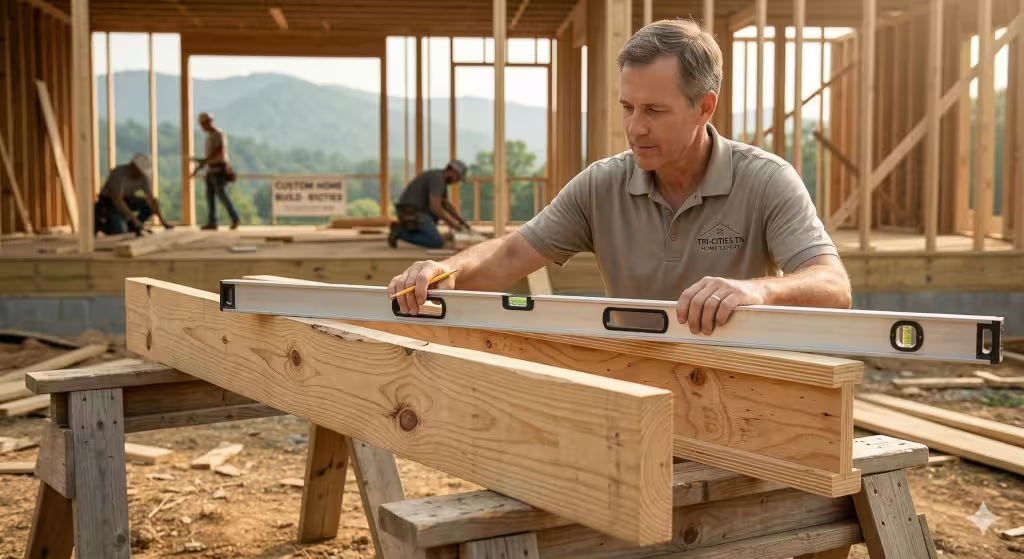
Wood is a natural material, and it loves to soak up water. When sawn lumber is cut, it is often “green,” which means it still has a lot of moisture in it. Even if it is kiln-dried, it usually has about 19% moisture. As that wood dries out inside your heated and cooled home, it can shrink, twist, or bow. This is often what causes “nail pops” in your drywall or squeaks in your floor.
LVL is different. It is made in a factory where the moisture is strictly controlled to be between 8% and 12%. Because it is already dry and made of many glued layers, it does not warp or twist like sawn lumber does. In our humid East Tennessee summers and wet winters, that stability is a huge advantage. It means your walls stay straighter and your floors stay quieter over time.
Cost-Benefit Analysis for Custom Home Buyers
If you look at the price tag at the lumber yard, a piece of LVL is going to cost more than a piece of sawn lumber. However, we have to look at the total value of your build. Because LVL is stronger, we might be able to use fewer beams to do the same job.
Using LVL also saves money on labor. When we use sawn lumber, my crew often has to spend time sorting through the pile to find the straightest boards. We call this “culling.” We end up throwing away boards that are too twisted to use. With LVL, every single piece is perfectly straight and ready to go. Plus, because it does not shrink, you won’t have to pay someone to come back and fix drywall cracks or floor squeaks a year after you move in. In the long run, investing in better bones saves you money and stress.
Frequently Asked Questions about LVL vs. Solid Sawn Timber
A lot of buyers have questions about wood, and we want to make sure you have the answers. A common one is: “Is LVL stronger than regular wood?” The answer is a big yes. In almost every way we measure strength, the engineered process makes LVL superior to sawn lumber because it removes the natural flaws found in trees.
Another question is: “When should I use sawn lumber instead?” We still use sawn lumber for a lot of things! It is perfect for the studs inside your walls, for rafters on smaller roofs, or for things like decks where the wood will be outside. It is a great, cost-effective choice for parts of the house that don’t have to carry massive weights over long distances.
Finally, people ask: “Can you cut or notch an LVL?” This is where you have to be careful. Because an LVL is a piece of engineering, you cannot just cut a hole in it wherever you want like you might with sawn lumber. You have to follow the manufacturer’s rules very closely, or you could make the beam unsafe. This is why having an expert builder is so important.
Precision Leads to Peace of Mind
At the end of the day, building a home is about creating a place where you feel safe and comfortable. Whether we are using sawn lumber for your walls or heavy-duty LVL beams to give you that beautiful open floor plan, my goal is to make sure everything is done with precision. Sawn lumber will always have a place in our homes, but understanding when to upgrade to an engineered product is key to a high-quality build.
I want your home in the Tri-Cities to stand strong for generations. When we use the right materials for the right job, we build with integrity. If you are thinking about building and want to make sure your home’s structure is designed the right way, I would love to help you look at your plans.
Bonus Section: A Comparison Chart of the Strength of the Two Woods
When we look at a standard 16-foot span, which is a very common distance for a medium-sized living room or a large master bedroom, the difference between these two materials becomes very clear.
Most builders look at how much “dead load” (the weight of the house itself) and “live load” (the weight of people and furniture) a beam can handle before it bends too much. In our corner of Tennessee, we want a floor that feels stiff, not like a trampoline.
Comparison Chart: 16-Foot Span Performance
| Feature | Solid Sawn Lumber (2×12 Douglas Fir #2) | LVL (1.75″ x 11.875″ 2.0E) |
| Max Allowable Load | Approx. 180 lbs per linear foot | Approx. 450+ lbs per linear foot |
| Stiffness (E-Value) | 1.6 Million psi | 2.0 Million psi |
| Bending Strength ($F_b$) | 900 psi | 2,800 – 3,100 psi |
| Thickness Needed | Often requires 2 or 3 boards nailed together | Usually a single or double ply |
| Risk of Squeaks | Higher (due to natural shrinking) | Very Low (dimensionally stable) |
| Typical Use | Standard residential floor joists | Heavy-duty headers and open-concept spans |
Understanding the Results
When we use sawn lumber for a 16-foot stretch, we are often pushing the wood to its limit. If you have a heavy granite island or a large bathtub sitting on sawn lumber, you might notice the floor starts to dip over time. Because sawn lumber is a natural product, one board might be stronger than the one next to it.
With LVL, we have much more “headroom.” It can carry more than double the weight of sawn lumber over that same 16-foot distance. This is why I almost always recommend LVL for the “spine” of your home. It ensures that your tile floors won’t crack and your doors will always swing shut perfectly because the frame isn’t shifting or sagging.
Sawn lumber is still a fantastic choice for the shorter spans in your home, like laundry rooms or smaller bedrooms, where the weight is lower and the distance is shorter. It is all about using the right tool for the job to keep your budget in check while keeping your structure rock solid.