

Guaranteed Replacement Cost
When people build or buy a high-end property, one of the most common questions they ask is: is guaranteed replacement cost worth it for custom homes?
The short, direct answer is yes. In fact, guaranteed replacement cost is one of the single most important protections you can put on a custom house.
A custom home is not a cookie-cutter structure built from standard stock materials in a flat subdivision. It is a unique piece of engineering designed specifically for your lifestyle and your land. When disaster strikes, whether from a catastrophic house fire, a severe windstorm, or a falling tree, rebuilding a custom home presents challenges that standard insurance policies simply do not handle well.
Many homeowners assume that their standard policy will take care of everything if their house burns to the ground. That is a dangerous assumption. In this guide, I will walk you through the math, the job-site realities, and the legal and structural details of custom home reconstruction. We will look at why standard coverage falls short, how guaranteed replacement cost protects your family from massive out-of-pocket bills, and how you can make sure your property is fully protected.
The Total Loss Paradox: Why Rebuilding Costs More Than Building New

To understand why guaranteed replacement cost is so important, you first have to understand what I call the total loss paradox. Most homeowners believe that if a home costs one million dollars to build on raw land, it will cost that same one million dollars to rebuild if it burns down. As a builder who has managed major property losses and insurance rebuilds, I can tell you that rebuilding after a total loss usually costs 20 percent to 40 percent more than building on a clean, empty lot.
Why does an insurance rebuild cost so much more?
First, you have to deal with demolition, hazardous waste handling, and debris removal. When you build a new home, the excavator clears trees and moves clean dirt. When a home burns down, you are left with tons of charred timber, melted plastics, broken glass, scorched appliances, and toxic ash. That debris cannot just be pushed into a pile. It must be carefully loaded into heavy dumpsters, hauled away by licensed waste haulers, and taken to approved disposal facilities. In many areas, local environmental regulations require testing for asbestos, lead, and chemical runoff before you can even touch the site. That debris removal process alone can easily cost thirty thousand to seventy thousand dollars before a single new board is nailed down.
Second, the foundation must be evaluated or replaced entirely. Intense heat from a house fire ruins the structural integrity of concrete and masonry. Concrete contains small pockets of moisture. When exposed to extreme temperatures, that moisture expands rapidly, causing the concrete to crack, spall, and lose its compressive strength. Rebar inside the concrete can warp and lose its structural tension. That means the entire concrete foundation, including footings, stem walls, and basement slabs, often has to be jackhammered out, hauled away, and poured completely new.
Third, site re-engineering and utility work add significant expense. When a home is destroyed, underground water lines, septic lines, gas connections, and electrical feeds are often damaged by heat or heavy demolition equipment. If your home sits on a sloped mountain lot, which is very common here in the Tri-Cities area, heavy machinery working on the site can destabilize retaining walls and soil grades. You have to bring in geotechnical engineers and structural surveyors to re-test the soil and redesign the foundation support.
Fourth, you lose all economies of scale. When a builder puts up homes in a planned neighborhood, they buy materials by the trainload and hire trade crews for months at a time. A custom rebuild is a one-off project. Your builder cannot negotiate volume discounts on lumber, windows, or custom cabinetry for a single home. You pay full retail price for every piece of material and every hour of trade labor.
When you add up demolition, foundation removal, engineering fees, utility repairs, and standalone labor rates, a home that was insured for eight hundred thousand dollars can easily cost over one million dollars to reconstruct. Without guaranteed replacement cost, the homeowner is stuck paying that extra two hundred thousand dollars straight out of their personal savings. With guaranteed replacement cost, the insurance company steps up and covers the full bill to put the home back exactly the way it was.
Coverage Breakdown: How Guaranteed Replacement Cost Compares to Other Policies
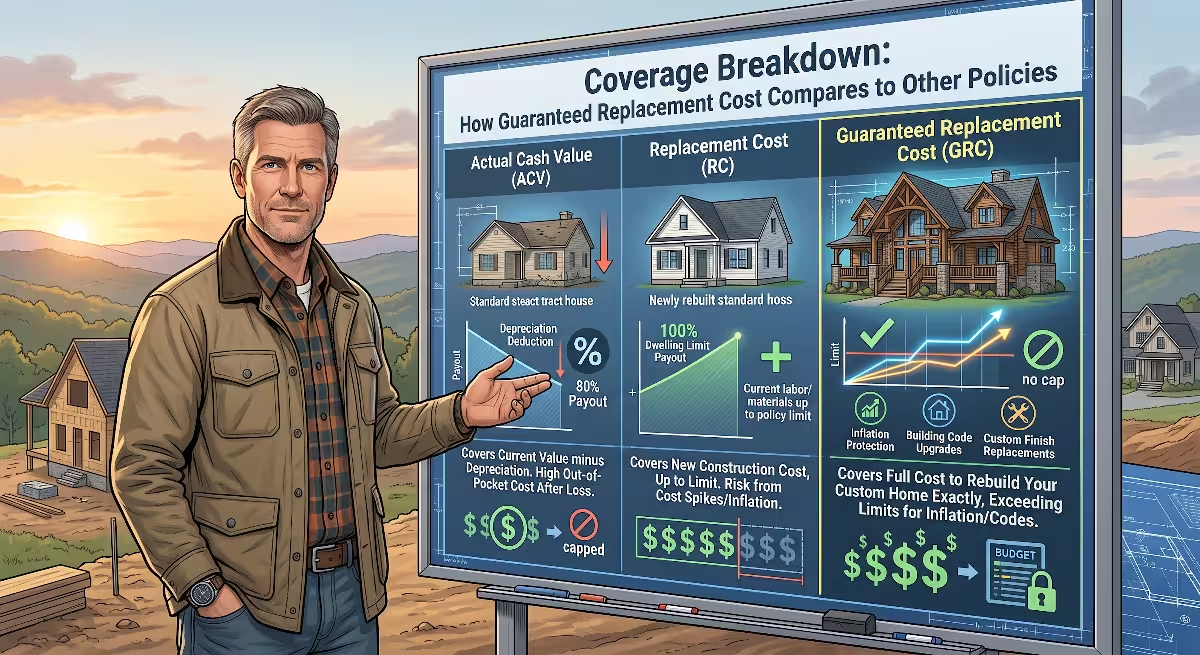
To see the real value of guaranteed replacement cost, we need to compare it directly to the other three common types of property insurance coverage. Insurance policies handle rebuild costs in four very different ways.
+---------------------------------------------------------------------------------------------------+
|                                 HOW HOME INSURANCE POLICIES PAY OUT                                |
+-------------------------------+-----------------------------------+-------------------------------+
| Coverage Type                 | Maximum Payout Limit              | Risk to Custom Homeowner      |
+-------------------------------+-----------------------------------+-------------------------------+
| Actual Cash Value (ACV)       | Depreciated Value Only            | Severe (Major Out-of-Pocket)  |
| Standard Replacement Cost     | 100% of Stated Policy Limit       | High (Stops at Policy Limit)  |
| Extended Replacement Cost     | 125% to 150% of Policy Limit      | Moderate (Still Has a Cap)    |
| Guaranteed Replacement Cost   | Full Actual Cost (No Dollar Cap)  | None (Complete Protection)    |
+-------------------------------+-----------------------------------+-------------------------------+
Actual Cash Value (ACV)
Actual cash value is the most basic and least protective form of property insurance. Under an actual cash value policy, the insurer calculates what it costs to replace the damaged item and then subtracts depreciation based on age and wear.
For example, suppose your custom home has a high-end cedar shake roof or architectural slate roof that was installed fifteen years ago and is designed to last thirty years. If a severe storm destroys that roof, an actual cash value policy will only pay you half of what the roof is worth today because it is halfway through its lifespan. The same depreciation applies to your hardwood floors, custom kitchen cabinets, HVAC systems, and plumbing fixtures.
If a custom home experiences a total loss under an actual cash value policy, the payout will fall hundreds of thousands of dollars short of what a builder charges to rebuild. For a custom home, an actual cash value policy is an absolute disaster waiting to happen.
Standard Replacement Cost
Standard replacement cost is a big step up from actual cash value because it pays to repair or replace damaged property without deducting for depreciation. If your ten-year-old custom walnut cabinets burn down, standard replacement cost pays for brand new cabinets of similar kind and quality.
However, standard replacement cost comes with a hard ceiling. It will only pay up to the exact dollar limit listed on your policy declarations page under Coverage A (Dwelling Coverage). If your home is insured for seven hundred and fifty thousand dollars, the insurance company will never pay a single penny over seven hundred and fifty thousand dollars.
If inflation drives up the price of framing lumber, or if local trade labor rates jump after a regional storm, your rebuild cost could easily climb to nine hundred thousand dollars. Under standard replacement cost, the insurer writes a check for seven hundred and fifty thousand dollars and walks away, leaving you to find the remaining one hundred and fifty thousand dollars on your own.
Extended Replacement Cost
To help protect homeowners from unexpected cost spikes, many insurance carriers offer extended replacement cost. This coverage takes your baseline dwelling limit and adds an extra percentage cushion, usually 25 percent or 50 percent above your stated limit.
If your custom home has a baseline limit of eight hundred thousand dollars and you have a 25 percent extended replacement cost endorsement, your maximum available coverage expands to one million dollars. If you have a 50 percent endorsement, your maximum payout expands to one million two hundred thousand dollars.
Extended replacement cost is a solid choice and offers far better protection than standard replacement cost. But it is still a capped policy. If catastrophic inflation, complex structural engineering, or extensive foundation demolition pushes the rebuild cost above that extended percentage cap, you are once again personally responsible for the difference.
Guaranteed Replacement Cost
Guaranteed replacement cost is the gold standard of homeowners insurance. Under a true guaranteed replacement cost policy, the insurance company agrees to pay whatever it actually costs to rebuild your home to its pre-loss condition, using materials of like kind and quality, with no dollar cap on the payout.
If your custom home is insured for eight hundred thousand dollars, but sudden supply chain shortages, specialized trade labor, and steep mountain site prep drive the actual reconstruction cost to one million three hundred thousand dollars, a guaranteed replacement cost policy pays the full one million three hundred thousand dollars.
You do not have to settle for cheaper materials, you do not have to cut square footage, and you do not have to drain your retirement accounts to finish the job. This uncapped safety net is why guaranteed replacement cost is so widely recommended by custom home builders, architects, and structural engineers.
Why Custom Homes Face Massive Replacement Cost Gaps
In my years managing construction projects, I have seen firsthand why custom homes are so vulnerable to insurance shortfalls. Production homes built in large subdivisions are relatively easy for an insurance computer algorithm to estimate. Those homes use standard framing dimensions, off-the-shelf trusses, builder-grade vinyl windows, and mass-produced kitchen cabinets.
Custom homes are completely different animals. Let us look at the specific reasons why custom homes experience massive cost gaps during insurance claims and why guaranteed replacement cost is the only reliable way to close those gaps.
                      CUSTOM HOME REBUILD COST DRIVERS
                                      │
     ┌──────────────────┬─────────────┴─────────────┬──────────────────┐
     ▼                  ▼                           ▼                  ▼
Bespoke Materials  Artisan Labor             Challenging Sites   Demand Surges
(Custom Millwork,  (Trim Carpenters,         (Slopes, Rock,      (Regional Storms,
Imported Tile,     Masons, Specialist        Narrow Drives,      Material Spikes,
Heavy Timbers)     Trades)                   Cranes Needed)      Labor Shortages)
Bespoke Materials and Custom Architectural Detailing
A custom home often features materials that you cannot simply pick up at the local lumberyard. In custom builds across East Tennessee, we frequently install wide-plank white oak flooring, hand-hewn Douglas fir timbers, site-built custom staircases, hand-cut stone masonry fireplaces, and custom-fabricated steel handrails.
Consider custom kitchen and bathroom cabinetry. In a production home, cabinets come in standard three-inch width increments from a factory warehouse. In a true custom home, a local cabinetmaker measures the space to the millimeter and builds solid wood boxes with inset doors, custom stain finishes, and specialty hardware. Replacing custom cabinetry requires custom fabrication, detailed shop drawings, and weeks of careful installation.
When an insurance appraiser uses standard estimating software, their program often defaults to regional averages for standard cabinetry and stock trim. If your policy lacks guaranteed replacement cost, your payout will be based on standard builder-grade materials rather than the bespoke, artisan-grade finishes you actually had. A guaranteed replacement cost policy requires the insurer to pay for true like kind and quality, preserving the craftsmanship and value of your home.
Artisan Labor Scarcity and Specialist Billing Rates
The building industry has faced a shortage of skilled trade labor for many years. Finding a framing crew to put up standard walls is one thing, but finding master trim carpenters, certified timber framers, skilled slate roofers, and master stone masons is entirely different.
Artisan craftsmen charge premium hourly rates because their skills take decades to master. When building a custom home with vaulted timber ceilings, complex roof hips and valleys, and intricate crown molding profiles, the labor hours pile up quickly.
After a total loss, your rebuild cannot be handed to an entry-level production crew without sacrificing the fit, finish, and structural beauty of the home. Guaranteed replacement cost ensures that your insurance payout covers the real billing rates of top-tier craftsmen rather than the lowest bid on a regional software spreadsheet.
Topography, Rocky Ground, and Difficult Site Access
Where you build matters just as much as what you build. Here in the Tri-Cities region and throughout Appalachia, custom homes are often built on ridge lines, steep mountain slopes, or private wooded acreage with long, winding gravel driveways.
Building or rebuilding on a sloped lot requires specialized engineering. You need deep concrete footings anchored into solid bedrock, engineered retaining walls, extensive foundation drainage systems, and carefully planned soil grading. If a fire destroys the home, getting heavy demolition equipment, concrete mixer trucks, and crane rigs up a narrow, steep driveway is difficult and expensive.
In many cases, building materials must be staged off-site and shuttled up the hill in smaller trucks, or lifted into place using specialized crane equipment. These site logistics add thousands of dollars to equipment rental and labor line items. Standard insurance estimators rarely account for tough terrain when establishing baseline policy limits. Having guaranteed replacement cost protects you against the heavy expenses that come with rebuilding on difficult land.
Demand Surge and Supply Chain Shocks Following Disasters
When a severe weather event hits an entire region, such as a major tornado, a widespread hail storm, or a devastating wildfire, thousands of homes are damaged at the exact same time. This creates an economic phenomenon known in the construction and insurance industries as demand surge.
During a demand surge, the local demand for building materials and labor skyrockets overnight. The price of framing lumber, plywood, roofing shingles, and drywall can double in a matter of weeks. Subcontractors who were charging standard rates are suddenly booked out for two years, and their labor prices increase dramatically.
       Catastrophic Regional Disaster (Storm, Tornado, Fire)
                                │
                                ▼
         Thousands of Properties Damaged Simultaneously
                                │
                                ▼
         Extreme Shortage of Materials and Trade Crews
                                │
                                ▼
       Material Prices Spike + Labor Hourly Rates Double
                                │
                                ▼
     Standard Policy Limits Exhausted (Homeowner Faces Big Gap)
                                │
                                ▼
   GUARANTEED REPLACEMENT COST PAYS FULL INFLATED REBUILD BILL
If your home is destroyed during a regional disaster, a standard policy limit that seemed perfectly adequate six months earlier will fall short due to inflated prices. With guaranteed replacement cost, your policy automatically adjusts to whatever the open construction market demands, shielding your family from price spikes caused by regional emergencies.
Critical Policy Endorsements Custom Homeowners Overlook

When designing an insurance package for a custom home, guaranteed replacement cost serves as the main structural beam of your coverage. However, just like a well-built home needs rafters, joists, and shear walls to make the entire frame rigid, your insurance policy needs specific supporting endorsements to provide complete protection.
When you sit down with your insurance agent, make sure you discuss these three essential policy add-ons alongside guaranteed replacement cost.
+---------------------------------------------------------------------------------------------------+
|                        CRITICAL ENDORSEMENTS TO PAIR WITH GUARANTEED REPLACEMENT COST             |
+------------------------------------+--------------------------------------------------------------+
| Endorsement Name                   | What It Protects and Pays For                                |
+------------------------------------+--------------------------------------------------------------+
| Ordinance or Law Coverage          | Required building code upgrades (energy, electrical, seismic)|
| Architectural & Engineering Fees   | Re-drafting custom CAD plans, soil tests, permit stamps      |
| Extended Loss of Use               | Rent and living expenses for 18 to 24 month custom rebuilds  |
| Water Backup & Sump Overflow       | Damage from drain backups and finished basement flooding     |
| Underground Utility Line Coverage  | Excavation and repair of buried water, sewer, and power lines|
+------------------------------------+--------------------------------------------------------------+
Ordinance or Law Coverage (Building Code Upgrades)
Building codes are updated every few years to improve structural safety, energy efficiency, and fire resistance. When you rebuild a damaged home, local municipal building inspectors will require the new construction to meet the latest adopted building codes, not the codes that were in place when the home was originally built.
For example, modern codes may require updated arc-fault circuit breakers throughout the electrical system, higher R-value spray foam insulation, impact-rated windows, engineered hurricane straps on roof trusses, or residential fire sprinkler systems.
A standard property policy only pays to rebuild the home as it was originally designed. It explicitly excludes the extra cost of bringing older systems up to modern building codes. Ordinance or law coverage fills this gap by paying for the mandatory code upgrades required by local building departments. When paired with guaranteed replacement cost, ordinance or law coverage ensures that your new home meets all modern legal building standards without costing you out of pocket.
Architectural and Engineering Fees Endorsement
When a production home is rebuilt, the builder often uses standard stock blueprints that cost very little to reproduce. When a custom home is destroyed, the design process is much more complex.
Even if you have a copy of your original architectural drawings, you cannot simply hand them to a framer and start building. A licensed architect and a structural engineer must review the plans, update them for current building codes, re-calculate structural load paths, and produce stamped construction documents for municipal permitting.
Architectural and engineering fees on a high-end custom home routinely run between 8 percent and 15 percent of total construction costs. On a one million dollar rebuild, that represents eighty thousand to one hundred and fifty thousand dollars in professional design fees. Make sure your policy explicitly includes an endorsement for architectural and engineering fees so these necessary soft costs do not eat into your physical construction budget.
Extended Loss of Use and Living Expenses
Rebuilding a custom home takes time. While a simple production home can be framed and finished in four to six months, a one-of-a-kind custom home with complex timber framing, extensive masonry, and bespoke millwork routinely takes twelve, eighteen, or even twenty-four months to construct.
During that time, you and your family need a place to live that matches your normal standard of living. Standard insurance policies often cap loss of use coverage to twelve months or a limited dollar amount. If your custom rebuild takes twenty months, your living expense benefits could run out eight months before the house is completed.
Make sure your policy includes extended loss of use coverage that provides adequate living expense funds for at least twenty-four months. This gives your builder the necessary time to source premium materials, complete intricate finish work, and cure masonry and plaster properly without rushing the construction process.
A Builder’s Step-by-Step Guide to Calculating Accurate Replacement Valuation
To get the full benefit of guaranteed replacement cost, you and your insurance provider must establish an accurate baseline dwelling limit. Most insurance carriers require you to insure your home for 100 percent of its estimated replacement cost at policy inception before they will grant a guaranteed replacement cost endorsement.
Here is the exact step-by-step process I recommend to determine an accurate replacement valuation for a custom home.
                    CALCULATING CUSTOM REPLACEMENT VALUE
                                      │
     ┌──────────────────┬─────────────┴─────────────┬──────────────────┐
     ▼                  ▼                           ▼                  ▼
Step 1: Separate   Step 2: Get a       Step 3: Add Demo,   Step 4: Lock In
Market Value from  Detailed Builder    Site Prep & Soft    Annual Inflation
Rebuild Cost       Spec Sheet          Costs (15-20%)      Guard Updates
Step 1: Separate Real Estate Market Value from Rebuild Cost
One of the biggest mistakes custom homeowners make is confusing market value with replacement cost. Market value is what someone will pay to buy your property today. It includes the value of your raw land, your neighborhood location, school district ratings, and local real estate supply and demand.
Replacement cost is strictly the physical cost of labor, materials, equipment, site clearing, engineering, and contractor management needed to construct the building.
In some markets, your replacement cost might be significantly higher than your market value, especially in rural areas where land is inexpensive but bringing specialized trades to the site costs more. In other markets, replacement cost might be lower than market value because prime land makes up a large portion of the sale price. Never base your dwelling insurance limit on a real estate sales appraisal or property tax assessment. Always base it on a true construction cost estimate.
Step 2: Build a Comprehensive Construction Spec Sheet
Work with your custom builder, architect, or a professional construction cost estimator to create a detailed specification sheet for your home. This document should go far beyond basic square footage and room counts.
Make sure your spec sheet documents:
- Foundation type, including basement wall height, concrete thickness, and drainage waterproofing systems.
- Exterior wall framing dimensions (such as two-by-six framing with exterior rigid insulation versus standard two-by-four framing).
- Roof pitch, framing type (custom stick-framed rafters versus pre-engineered trusses), and roofing material specifications.
- Interior ceiling heights, coffered ceiling details, vaulted timber beams, and custom drywall finishes.
- Cabinetry linear footage, wood species, door construction, and countertop materials (such as quartzite, marble, or premium granite).
- Mechanical systems, including multi-zone variable-speed heat pumps, geothermal loops, radiant floor heating, and whole-house backup generators.
- Plumbing fixtures, including custom tile showers with multiple shower heads, freestanding soaking tubs, and tankless water heaters.
Having this level of detailed documentation ensures that your insurance carrier inputs the correct parameters into their underwriting tools, creating an accurate baseline for your guaranteed replacement cost coverage.
Step 3: Account for Demolition, Site Clearing, and Engineering Expenses
Once you have calculated the baseline cost to build the structure, you must add allowances for the unique costs of rebuilding after a loss.
As we discussed in the total loss paradox, you should budget an additional 15 percent to 20 percent above new construction costs to cover:
- Safe demolition and structural sorting of charred materials.
- Heavy hauling, tipping fees, and hazardous material disposal at licensed landfills.
- Foundation excavation, rock hammer work, and concrete haul-away.
- Civil engineering, structural drafting, and updated municipal permitting fees.
Factoring in these post-disaster costs ensures that your initial dwelling limit is realistic, giving your guaranteed replacement cost endorsement the solid foundation it needs.
Step 4: Include Contractor Overhead, Profit, and Project Management
Rebuilding a custom home requires full-time professional project management. A licensed general contractor must coordinate dozens of specialized subcontractors, order hard-to-find materials, manage municipal building inspections, and maintain job-site safety.
Legitimate general contractor overhead and profit (often referred to in the industry as O&P) typically ranges from 15 percent to 25 percent of the total project cost. Insurance companies sometimes attempt to exclude or minimize contractor overhead and profit in initial estimates. Your baseline replacement valuation must explicitly account for professional builder management fees so that a qualified custom contractor can be hired to manage your rebuild.
Step 5: Establish an Automatic Inflation Guard
Construction costs change constantly. The cost of framing lumber, copper wiring, concrete, and skilled labor fluctuates based on national economic trends, fuel prices, and global supply chains.
Ensure that your policy includes an automatic inflation guard endorsement. This feature automatically adjusts your baseline dwelling coverage limit upward at each annual policy renewal to match regional construction cost indices. When combined with guaranteed replacement cost, an active inflation guard prevents your policy from falling behind changing market realities over time.
Frequently Asked Questions about Guaranteed Replacement Cost
Here are clear, straightforward answers to the most common questions custom homeowners ask about guaranteed replacement cost.
What is the difference between guaranteed replacement cost and extended replacement cost?
The primary difference is that extended replacement cost has a strict dollar cap, while guaranteed replacement cost has no dollar ceiling. Extended replacement cost adds a fixed percentage cushion, typically 25 percent or 50 percent above your stated dwelling limit. If your rebuild exceeds that percentage buffer, you must pay the rest yourself. Guaranteed replacement cost pays the full actual cost to reconstruct your home to its original condition, no matter how high the final bill climbs.
Why is guaranteed replacement cost getting harder to find?
In recent years, severe weather events and rapid construction material inflation have caused insurance carriers to pay out massive claims. Because guaranteed replacement cost requires the insurer to take on unlimited financial risk for rebuild cost overruns, many standard mass-market insurance companies have phased it out in favor of capped extended replacement policies. However, premier high-value home insurance carriers still offer guaranteed replacement cost to qualified custom homeowners.
Does guaranteed replacement cost cover the cost of my land?
No. Homeowners insurance covers physical buildings, structures, and site improvements. It does not insure the value of the underlying dirt or land. If a disaster destroys your house, the land remains yours. Guaranteed replacement cost pays to clear the debris, repair damaged structural grading, and rebuild the home on that land.
How much extra does guaranteed replacement cost add to my annual premium?
For most custom homes, adding guaranteed replacement cost increases your annual homeowners insurance premium by approximately 5 percent to 15 percent compared to a standard policy. On an annual premium of two thousand five hundred dollars, that represents an extra one hundred and twenty-five to three hundred and seventy-five dollars per year. Considering that a single rebuilding gap after a fire can easily exceed one hundred and fifty thousand dollars, guaranteed replacement cost provides exceptional financial return for a modest extra cost.
Can I get guaranteed replacement cost on an older custom home?
Yes, but older custom homes usually undergo more thorough underwriting. The insurance carrier will want to inspect the property to verify the age and condition of the electrical wiring, plumbing supply lines, heating systems, and roof. If the home has historic detailing or outdated structural elements, the insurer may require specialized historic replacement endorsements alongside guaranteed replacement cost to ensure authentic craftsmanship can be replicated.
What happens if my original custom builder is no longer in business?
A guaranteed replacement cost policy does not require you to use your original builder. You are free to hire any licensed, qualified custom general contractor to rebuild your home. The policy pays the reasonable and customary costs charged by local custom builders to restore the home to its documented pre-loss specifications using materials of like kind and quality.
Real-World Comparison: Rebuilding a Custom Home in East Tennessee
To show you exactly how these numbers play out in real life, let us walk through a practical construction case study based on a custom home in the Tri-Cities area.
Imagine a four-thousand-square-foot custom home built on a gently sloping lot in Johnson City. The home features hand-scraped hardwood floors, custom cherry cabinets, a vaulted great room with timber trusses, a stone fireplace, and a three-car garage.
+---------------------------------------------------------------------------------------------------+
|                        CASE STUDY: 4,000 SQ FT CUSTOM HOME TOTAL LOSS REBUILD                     |
+-------------------------------------------------------------+-------------------------------------+
| Expense Category                                            | Actual Construction Rebuild Cost    |
+-------------------------------------------------------------+-------------------------------------+
| Debris Removal, Environmental Testing & Hazmat Hauling      | $45,000                             |
| Damaged Foundation Demolition & Engineered Re-pour          | $65,000                             |
| Architectural Drafting, Structural Engineering & Permits    | $55,000                             |
| Framing, Timber Trusses & Advanced Building Envelope        | $380,000                            |
| Exterior Masonry, Siding & Impact-Rated Windows             | $220,000                            |
| Mechanical, Electrical & High-Efficiency Plumbing Systems   | $160,000                            |
| Custom Cherry Cabinetry, Quartzite Tops & Interior Finishes | $290,000                            |
| Contractor Overhead, Project Management & Site Supervision  | $185,000                            |
+-------------------------------------------------------------+-------------------------------------+
| TOTAL ACTUAL RECONSTRUCTION EXPENSE                         | $1,400,000                          |
+-------------------------------------------------------------+-------------------------------------+
Now, let us look at what happens under different insurance policies if this home had a baseline Coverage A dwelling limit of one million dollars established three years earlier, before regional material price increases.
       TOTAL REBUILD BILL: $1,400,000 (Baseline Limit: $1,000,000)
                                │
     ┌──────────────────────────┼──────────────────────────┐
     ▼                          ▼                          ▼
Standard Replacement       Extended (+25%)            GUARANTEED
Cost Policy (No Buffer)    Replacement Policy         REPLACEMENT COST
     │                          │                          │
Insurance Pays: $1,000,000 Insurance Pays: $1,250,000 Insurance Pays: $1,400,000
Homeowner Pays: $400,000   Homeowner Pays: $150,000   Homeowner Pays: $0
(CRIPPLING SHORTFALL)      (SIGNIFICANT GAP)          (100% FULLY COVERED)
Outcome Under Standard Replacement Cost
The insurance carrier issues a check for the stated dwelling limit of one million dollars. The homeowner is personally responsible for the remaining four hundred thousand dollars. To complete the build, the family must take out a second mortgage, drain their retirement funds, or redesign the home to eliminate the timber trusses, custom cabinetry, and stone masonry.
Outcome Under 25 Percent Extended Replacement Cost
The policy expands by 25 percent above the baseline limit, paying out a maximum of one million two hundred and fifty thousand dollars. While this extra two hundred and fifty thousand dollars helps significantly, the homeowner still faces an out-of-pocket deficit of one hundred and fifty thousand dollars to finish the project.
Outcome Under Guaranteed Replacement Cost
The insurance company covers the entire one million four hundred thousand dollar reconstruction invoice. The custom woodwork is milled to exact dimensions, the foundation is properly engineered for the slope, the timber trusses are built by master craftsmen, and the family moves back into their home without spending a single dollar of their own savings beyond their standard policy deductible.
Action Steps: How to Protect Your Custom Home Investment Today
Protecting your custom home requires taking proactive, organized steps before bad weather or fire threatens your property. Here is a direct action plan you can follow right now.
                     ACTION PLAN FOR CUSTOM HOMEOWNERS
                                      │
     ┌──────────────────┬─────────────┴─────────────┬──────────────────┐
     ▼                  ▼                           ▼                  ▼
1. Audit Your      2. Request a High-  3. Build a Cloud    4. Schedule an
Current Policy     Value Policy with   Archive of Blue-    Annual Builder
Declarations Page  True GRC Coverage   prints & Receipts   Review
1. Audit Your Current Policy Declarations Page
Pull out your homeowners insurance policy and look closely at the declarations page. Check the exact wording under Coverage A (Dwelling). Look for phrases like “Actual Cash Value,” “Replacement Cost,” “Extended Replacement Cost,” or “Guaranteed Replacement Cost.”
If your policy lists a specific percentage cap (such as 125 percent or 150 percent), you have extended replacement cost, not guaranteed replacement cost. If you see no mention of extended or guaranteed coverage, you likely have a standard replacement cost policy that stops strictly at your stated limit.
2. Connect with an Independent Agent Specializing in High-Value Homes
Many standard direct-to-consumer insurance companies do not write guaranteed replacement cost coverage on custom homes. Reach out to an independent insurance broker who represents premier high-value insurance carriers such as Chubb, Cincinnati Insurance, Pure, or Erie Insurance.
These high-value carriers understand custom construction. They employ in-house structural appraisers who visit your home in person, measure custom millwork, evaluate exterior masonry, inspect mechanical systems, and calculate an accurate rebuild valuation that qualifies for true guaranteed replacement cost.
3. Build a Digital Archive of Blueprints and Finish Schedules
Do not let your construction documentation sit in a paper folder in your home office where a fire could destroy it. Create a secure digital cloud archive that contains:
- Complete architectural CAD plans, structural framing layouts, and elevation drawings.
- Detailed finish schedules listing flooring brands, paint colors, tile selections, and plumbing fixture models.
- High-resolution photographs and video walkthroughs of every room, including inside kitchen cabinets, utility rooms, crawlspaces, and attics.
- Invoices, receipts, and change orders from your builder and specialty subcontractors showing the exact cost of custom upgrades.
Having this documentation stored securely in the cloud gives your contractor and insurance adjuster immediate proof of your home’s true specifications following a loss.
4. Schedule an Annual Builder Review
Every two or three years, or whenever you complete a major home improvement project, ask a local custom builder or professional estimator to review your replacement valuation.
If you add a finished basement, build a detached garage, install a swimming pool, or upgrade to an outdoor kitchen, those improvements increase your total replacement cost. Keeping your baseline coverage aligned with current construction realities ensures that your guaranteed replacement cost endorsement remains fully effective.
Final Thoughts from the Job Site
Building a custom home is one of the most rewarding milestones in life. It represents years of hard work, thoughtful architectural design, and careful craftsmanship. You pick every board, every stone, and every fixture to create a sanctuary tailored specifically to your family.
As a builder who has spent decades working with concrete, timber, and steel across Tennessee, I know that unexpected disasters happen to good people every single day. When a storm rolls off the mountains or an electrical fire breaks out in the middle of the night, the quality of your insurance policy determines whether you can rebuild your dream home or face financial hardship.
Standard insurance policies are built for standard tract homes. Custom homes require custom protection. When you weigh the minor additional annual premium against the massive financial risk of post-disaster inflation, artisan labor rates, and complex site demolition, the conclusion is clear.
Guaranteed replacement cost is not just worth it for custom homes; it is the single most essential insurance tool you can own to protect your craftsmanship, your investment, and your family’s future.