Many people dream of moving to the mountains. They find a beautiful piece of rural land and think the hard part is over. They see a low price on a website and think they got a deal. But as an engineer and a builder, I have seen the “hidden costs” that come with that beauty. Building in our area is different than building in a flat subdivision. We have steep hills, thick rocks, and specific rules. My goal is to help you understand what you are getting into. I want you to have a calm and happy building experience. This guide will show you the real costs of turning raw acreage into a home site.
The Allure and the Reality of Raw Land
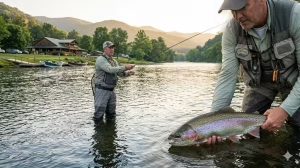
Buying rural land in the Tri-Cities is a dream for many. You want the view of Holston Mountain or a quiet spot near Boone Lake. You want space for your kids to run or a place to hunt and fish. But raw rural land is like a blank canvas that might have holes in it. When you buy a lot in a city like Johnson City, the water, sewer, and power are usually right at the curb. When you buy rural land, you are the one who has to bring the city to the lot.
Many buyers spend all their money on the land itself. They forget that the land is not ready for a house yet. Some folks spend $50,000 on a lot only to find out it needs $60,000 in work before the foundation can even be poured. This is why we talk about the hidden costs of building on rural land. You have to think about things like how to get a heavy power truck up a muddy hill. You have to think about where the dirty water goes if there is no city sewer. You have to think about the rock that sits just three feet under the grass.
In this article, I will explain these costs in a way that is easy to understand. We will look at the dirt, the water, the power, and the taxes. My hope is that by the end, you will be able to shop for rural land with your eyes wide open. You will know exactly what questions to ask. You will know how to budget so you don’t run out of money halfway through your build.
Site Preparation: Beyond Just “Moving Dirt”
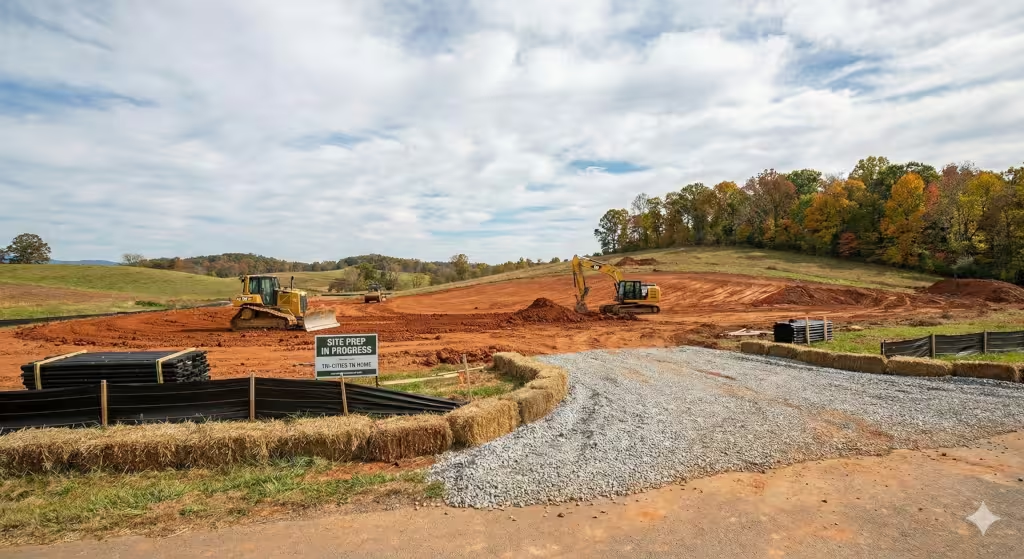
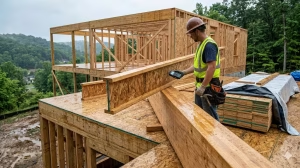
The first thing you do with rural land is prepare the site. This is often called “dirt work,” but it is much more than that. In East Tennessee, our rural land is rarely flat. We have ridges and valleys. To build a house, you need a flat spot. This means you have to cut into the hill or build up a flat pad.
First, you have to clear the land. This involves “clearing and grubbing.” Clearing means cutting down the trees. Grubbing means digging up the stumps and roots. If your rural land is covered in thick oaks and hickories, this takes big machines. You can’t just leave the stumps. If you build over a stump, it will rot over ten years. When it rots, the ground will sink. If the ground sinks under your porch, your porch will crack.
Once the trees are gone, you have to grade the land. Grading is about moving dirt to make it flat where the house goes. It is also about making sure water flows away from the house. In the Tri-Cities, we get plenty of rain. If your rural land is sloped toward your house, you will have a flooded basement every time it pours. You have to pay for an operator to spend days with a bulldozer or an excavator. They have to shape the land perfectly.
Another cost is erosion control. When you disturb the soil on rural land, the rain will wash it away. The law says you must stop this silt from getting into our local creeks and rivers. You have to install silt fences. These are those black fabric fences you see at construction sites. You might also need “rip-rap,” which is just large rocks placed in ditches to slow down water. If you don’t do this, you can be fined by the state. These costs can add up to thousands of dollars before you even have a floor.
The “Perk” Reality: Septic Systems vs. Sewer
Most rural land in our area does not have a city sewer pipe. This means you must have a septic system. A septic system is like a mini water treatment plant in your yard. It takes the waste from your home, settles the solids in a tank, and sends the liquid into the ground.
Before you buy rural land, you must get a “perk test.” This is also called a soil evaluation. A person from the state or a private soil scientist comes to the land. They dig holes to see how fast water soaks into the soil. In our area, we have a lot of clay. Clay does not soak up water very fast. If the water doesn’t soak in, the state will not let you build.
The state also decides how many bedrooms you can have based on the soil. If you want a four-bedroom house, but the rural land only “perks” for two bedrooms, you have a big problem. You might have to buy a different kind of system. A standard septic system might cost $5,000 to $8,000. But if your soil is bad, you might need an “engineered system.” This could involve a peat moss filter or a drip system. I have seen these cost $20,000 or even $30,000.
You also have to keep the area over your septic lines clear. You cannot build a pool or a shed over them. You cannot even drive a car over them. This means your rural land needs to have enough “usable” space for both the house and the septic field. Always make sure the perk test is done before you sign the final papers to buy the land.
Bringing the Power: Utility Extensions and Infrastructure
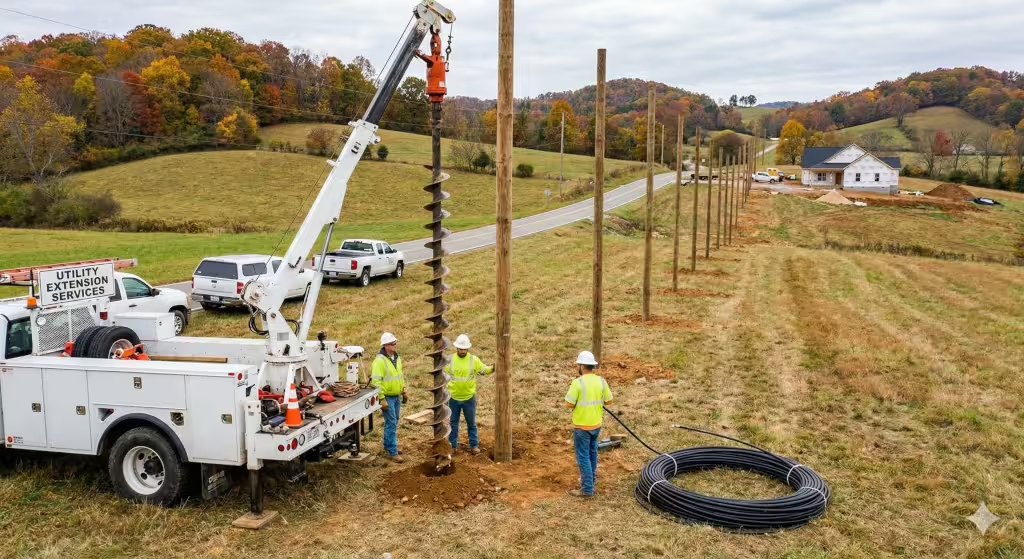
One of the biggest surprises on rural land is the cost of electricity. You might see a power pole down at the main road. You think, “Great, I’ll just plug in!” But if your house is 500 feet back in the woods, the power company has to bring that line to you.
In the Tri-Cities, we have great power companies like BrightRidge or BTES. They are very helpful, but they have to cover their costs. Usually, they will give you a certain amount of line for free. But if you are far away, you have to pay for every extra foot. You might have to pay for new poles. A single power pole can cost over $1,000 to $2,000 to install.
If you want the power lines to be underground so you don’t see them, it costs even more. Digging a trench on rural land is hard work. If the workers hit a layer of limestone rock, they have to bring in a special machine to hammer through it. This “rock charge” can be very expensive.
You also need a transformer. This is the big grey box that changes the high-voltage power from the street into the power your house can use. On rural land, you are often the only person using that transformer. You might have to pay the full cost of it. I always tell my clients to call the power company before they buy the land. Ask them for an estimate to bring power to the spot where you want to build. It could be $2,000, or it could be $15,000. You need to know that number early.
Water Wealth: Wells vs. Public Taps
Just like with the sewer, many pieces of rural land do not have city water. If you are lucky, a water line runs along the road. You just pay a “tap fee” to connect. This might cost $1,500 to $3,000. But if there is no water line, you have to drill a well.
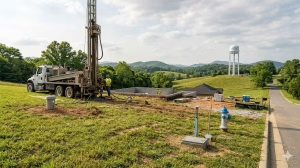
Drilling a well on rural land is a bit like gambling. You hire a driller to poke a hole deep into the earth. You hope they find a good “vein” of water. In East Tennessee, you might find water at 100 feet. Or you might have to go down 400 feet. You pay by the foot. If the driller goes 500 feet and finds nothing, you still have to pay them for the hole. This is called a “dry hole,” and it is a nightmare for a budget.
Once you find water, you have to test it. Rural land water can have things in it like sulfur or iron. Sulfur makes the water smell like rotten eggs. Iron makes your sinks turn orange. To fix this, you have to buy a water filtration system. A good system can cost $3,000 to $5,000.
You also need a pump to get the water from the bottom of the well up to your house. You need a pressure tank to keep the water flowing smoothly. All of these parts live on your rural land and need power to run. If the power goes out, your water stops too. Many people on rural land buy a generator just so they can keep their well pump running during a storm.
The Long Road Home: Driveways and Access
When you build on rural land, you need a way to get to your house. This is your driveway. In the city, a driveway is short and made of concrete. On rural land, a driveway can be very long.
A long driveway needs a good base. You can’t just drive on the dirt. When the heavy concrete trucks and lumber trucks come to build your house, they will sink into the mud. You have to build a “construction road” first. This means digging out the topsoil and putting down large “crusher run” rocks.
One of the biggest hidden costs is drainage for the road. If your rural land has a creek or a low spot, you need a culvert. A culvert is a large pipe that lets water go under the driveway. If you don’t use a big enough pipe, the first big rain will wash your driveway away.
Think about the slope, too. If your rural land is very steep, a gravel driveway will wash out every year. You might have to pave it with asphalt or concrete. Paving a 500-foot driveway is very expensive. It can cost more than the kitchen cabinets! You also have to think about how a fire truck would get to your house. Some counties have rules about how wide and how flat the driveway must be for emergency vehicles. If your driveway is too narrow, you might not get a building permit.
Legal and Tax Traps: Easements and Greenbelts
There are hidden costs on rural land that you can’t see with your eyes. These are “paper costs.” One big thing in Tennessee is the “Greenbelt” law. This is a law that helps farmers pay lower property taxes. If a piece of rural land is at least 15 acres and used for farming or timber, the taxes are very low.
However, if you buy that rural land and build a house on it, it might not be a farm anymore. When the land is “disqualified,” you might have to pay “rollback taxes.” This means you have to pay the difference between the low farm tax and the high residential tax for the last three years. This can be thousands of dollars. As of July 2026, the laws in Tennessee are changing to make this easier on the buyer, but you still need to check. Always ask your title company about Greenbelt taxes.
You also need to look for easements. An easement is a right for someone else to use your rural land. Maybe the power company has a right to cut trees in a 50-foot strip. Maybe a neighbor has a right to drive across your land to get to theirs. You cannot build your house on an easement. This can limit where you put your home.
Lastly, check the deed for restrictions. Some rural land has rules about what kind of house you can build. It might say “no mobile homes” or “no metal roofs.” Even if there is no Homeowners Association (HOA), these rules stay with the land forever. You don’t want to buy land for a tiny home only to find out the deed says the house must be at least 2,000 square feet.
Soft Costs: The Invisible Budget Eaters
When people think about the cost of building on rural land, they think about wood and nails. But there are “soft costs” too. These are the fees you pay for people to think and plan.
First is the survey. You must have a survey of your rural land. A surveyor finds the iron pins in the ground that show exactly where your land starts and ends. On big pieces of rural land, this is hard work. They have to walk through thick brush and up steep hills. A good survey can cost $1,000 to $3,000. You also might want a “topo survey.” This shows the “topography” or the shape of the hills. This helps the engineer plan the driveway and the house site.
Then there are permits. Each county in the Tri-Cities is different. Sullivan County might have different rules than Washington County. You have to pay for a building permit, a septic permit, and sometimes a permit to connect to the main road.
You also need to think about the “cost of money.” If you are taking out a loan to buy the rural land and build the house, you will pay interest. Since it takes longer to build on rural land, you will pay more interest before you even move in. Always keep a “contingency fund.” This is an extra pile of money (usually 10% to 20% of your budget) just for things you didn’t see coming.
Regional Specifics: The Tri-Cities Terrain Factor
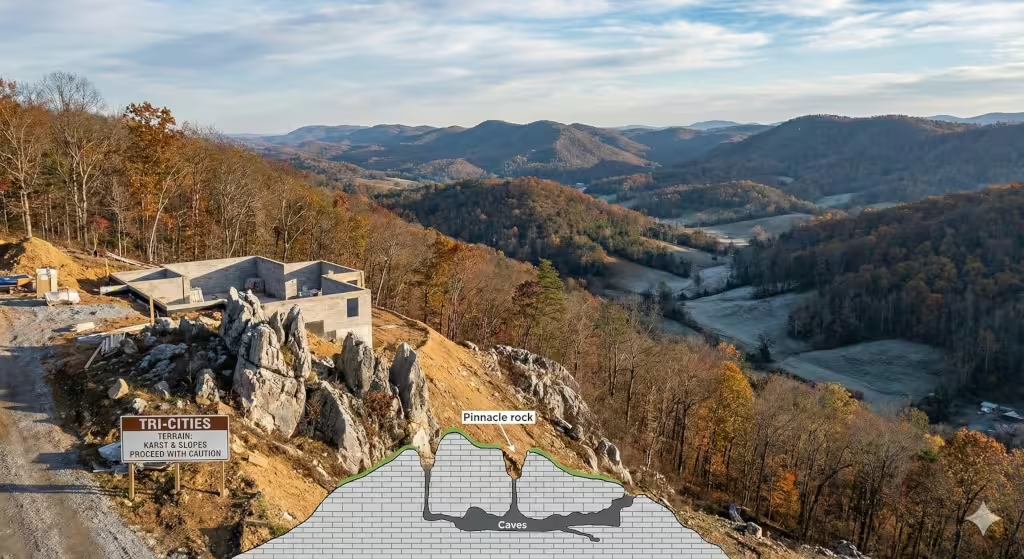
Our part of the world is beautiful because of the geology. But that same geology makes building on rural land tricky. We live in a “Karst” area. This is a fancy word for a place with a lot of limestone. Limestone is a soft rock that water can dissolve over thousands of years.
This means we have sinkholes. If your rural land has a sinkhole, you have to be very careful. You cannot just fill a sinkhole with dirt and build on it. The water will keep washing the dirt away, and your house will sink. Fixing a sinkhole can cost tens of thousands of dollars. You might need to use “piers,” which are long steel poles driven into the solid rock to hold up your house.
We also have “pinnacle rock.” This is when the underground rock looks like a bunch of jagged mountain peaks. If you dig for a basement on your rural land, you might hit a rock peak in one corner and soft dirt in the other. This makes the foundation very hard to build.
Lastly, think about the weather. In the winter, the “hollows” of our rural land stay cold and icy longer than the city. If your driveway is on the north side of a hill, it might be covered in ice for weeks. You might need to buy a tractor or a plow just to get to work. This is part of the cost of the rural lifestyle that people often forget.
Precision Planning for Your Custom Home
Building on rural land is a wonderful way to live. You get peace, quiet, and a connection to nature. But it is not the same as buying a lot in a neighborhood. It requires more planning and more money upfront. If you do the research before you buy, you won’t be stressed later.
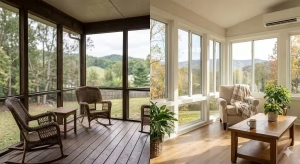
Take your time. Walk the rural land in the rain to see where the water goes. Talk to the neighbors about their wells. Call the power company. Get a soil test. If you do these things, you will be able to build a home that lasts for generations. You will be able to sit on your porch, look at the mountains, and know that your house is built on a solid foundation.
Building on rural land is an adventure. If you are prepared for the costs, it will be the best adventure of your life. Many families find their perfect slice of Tennessee. With a little bit of engineering and a lot of heart, you can too.