
Bringing the calm beauty of nature into a basement room is one of the smartest ways to make a below-grade space feel warm and inviting. Yet basement rooms present a tough biological puzzle. Almost every basement suffers from severe light deprivation, often measuring under 50 foot-candles of natural daylight. At the same time, below-grade rooms struggle with high seasonal relative humidity.
Here in Eastern Tennessee, from Johnson City and Kingsport to Bristol, our humid subtropical summers push damp air against cool underground foundations built into Appalachian karst limestone. When homeowners compare living shade plants vs. preserved moss for low light basements, they quickly discover that standard houseplant advice fails underground. Choosing between living shade plants and preserved moss requires looking closely at plant biology, basement air physics, and long-term maintenance.
True living shade plants offer active biological rewards like natural moisture release and fresh seasonal growth whenever supplemental light is present. By contrast, glycerin-preserved moss and forest lichens deliver zero-light texture, rich color, and sound absorption without needing a single drop of water, provided your basement humidity stays under control.
Photobiology and Light Thresholds: PPFD, Foot-Candles, and Zero-Light Reality
To choose the right greenery for an underground level, you first need to understand how plants use light as food. Human eyes adjust easily to dim rooms, which tricks us into thinking a basement corner is brighter than it really is. Plants do not adjust the same way. They rely on a strict budget of light energy to survive.
The Compensation Point of Deep-Shade Vascular Plants
Every green plant has a biological break-even line called the light compensation point. Above this line, a plant makes more sugar through photosynthesis than it burns to stay alive. Below this line, the plant slowly starves, drops its leaves, and dies. Even the toughest living shade plants need roughly 50 to 100 foot-candles of light for eight to ten hours every day just to hold their ground. In lighting science, that equals about 10 to 20 micromoles per square meter per second of Photosynthetic Photon Flux Density, or PPFD.
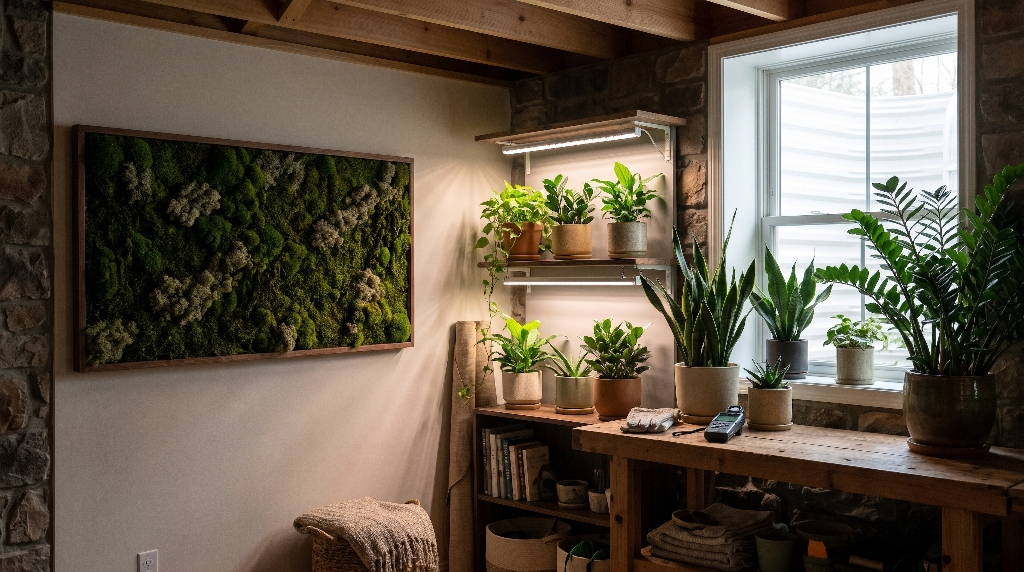
In Eastern Tennessee, a walkout basement or a basement with large south-facing egress windows can often hit those light levels near the glass. In those bright zones, living shade plants thrive without extra gear. However, an interior basement room with tiny hopper windows or no windows at all often measures under 5 foot-candles. In a windowless room, living shade plants cannot survive on ambient room lamps alone. You must install full-spectrum LED grow lights rated between 4000K and 6500K on a daily timer to feed their leaves.
Why Preserved Moss Thrives in Complete Darkness
Preserved moss solves the underground light problem by stepping outside of photosynthesis altogether. Harvesters gather real forest mosses and lichens from sustainably managed woodlands. Next, technicians dehydrate the plant cells and replace the natural sap with a mixture of vegetable glycerin, water, and food-grade mineral pigments.
Because glycerin locks the cellular structure in place, preserved moss is no longer biologically active. It does not need sunlight, soil, water, or fertilizer. In fact, direct sunlight or bright ultraviolet bulbs will actually fade its rich green color over time. That makes a dark, windowless basement media room, hallway, or home gym the ideal setting for preserved moss walls.
Basement Microclimate Physics: Relative Humidity, Mold, and Dew Point
Light is only half of the engineering equation below grade. Moisture control determines whether your basement greenery stays healthy or turns into a maintenance headache. Cool concrete walls and basement floor slabs pull moisture from the surrounding soil, creating unique indoor air challenges.
Hygroscopic Behavior of Preserved Moss in Damp Basements
The biggest mistake homeowners make with preserved moss is ignoring basement relative humidity. Vegetable glycerin is hygroscopic, which means it acts like a microscopic sponge that pulls water vapor straight out of the air. In a dry room, that trait keeps the moss soft and supple. In a damp basement, it causes trouble.
When basement relative humidity climbs above 60% to 65%, preserved moss absorbs too much ambient water. The fronds can feel wet to the touch, green dye can bleed onto drywall or wood frames, and airborne mold spores can settle on the damp surface. To keep preserved moss crisp and clean, your basement air must stay between 20% and 50% relative humidity. Across the Tri-Cities region, summer humidity regularly spikes outdoors, so running a reliable basement dehumidifier is essential before hanging preserved moss art.
Evapotranspiration and Soil Moisture Dynamics in Living Plants
Living shade plants interact with basement moisture in the exact opposite way. Through a natural process called evapotranspiration, potted plants pull water up through their roots and release clean water vapor through tiny pores in their leaves. Wet potting soil also evaporates slowly into the room.
In a dry winter basement heated by a furnace, a group of living shade plants adds gentle, helpful moisture to the air. In a muggy summer basement, however, damp potting mix dries out very slowly. Cool, wet soil invites root rot and attracts fungus gnats, tiny dark flies that breed in soggy organic matter. Using well-draining potting mix and letting the top two inches of soil dry out between waterings keeps both your living shade plants and your basement air in healthy balance.
Top Botanical Candidates: Best Living Shade Plants for Below-Grade Rooms
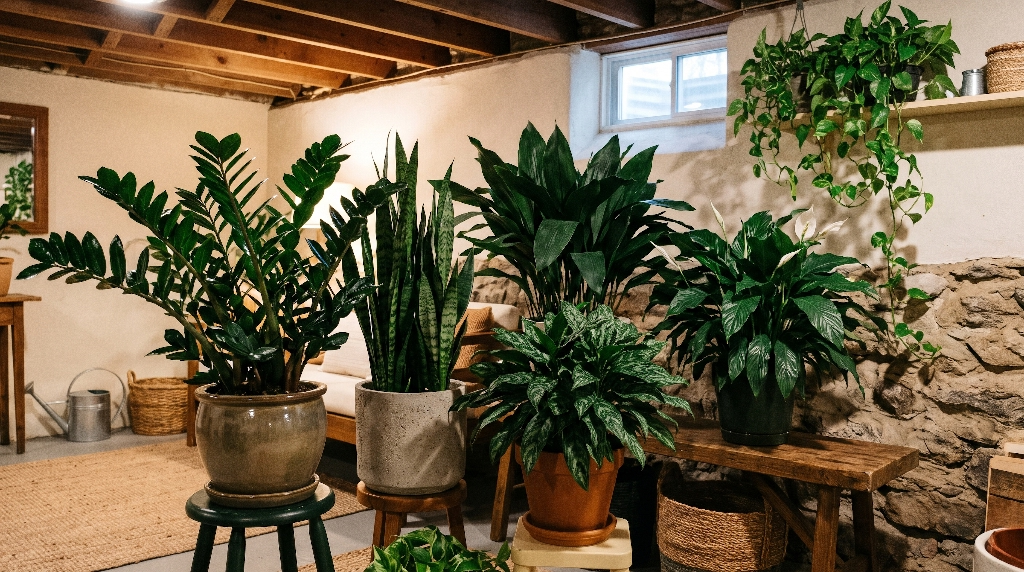
Not every houseplant labeled “low light” at a garden center can handle true basement conditions. Many tropical plants merely tolerate shade for a few months before thinning out. When selecting living shade plants for a basement with an egress window or a modest grow light, stick to species built for deep forest floors.
ZZ Plant and Cast Iron Plant
The ZZ plant (Zamioculcas zamiifolia) is widely considered the gold standard among living shade plants. Beneath the soil, it grows thick, potato-like rhizomes that store water and energy for months. Above ground, its waxy, dark green leaflets reflect scarce light efficiently and resist dust buildup. It tolerates light levels down to 25 to 50 foot-candles and only needs water every two to three weeks in a cool basement.
The cast iron plant (Aspidistra elatior) earns its tough name from its ability to endure deep shade, cool drafts, and missed waterings. Native to the shaded forest understories of Japan and Taiwan, its broad, leathery leaves pack dense chlorophyll to capture every stray photon. Both of these living shade plants bring bold architectural form to basement corners without demanding daily attention.
Snake Plant and Chinese Evergreen
The snake plant (Dracaena trifasciata) offers upright, sword-like foliage that fits neatly into narrow basement hallways or beside media consoles. Unlike most houseplants, snake plants use a specialized water-saving pathway called Crassulacean Acid Metabolism, or CAM. They open their leaf pores at night to take in carbon dioxide, which reduces water loss and helps them survive cool, dim rooms with ease.
The Chinese evergreen (Aglaonema commutatum) adds lush, patterned foliage to low-light rooms. When shopping for this species, choose varieties with dark emerald leaves rather than bright pink or white patterns. Dark green leaves contain more chlorophyll, allowing these living shade plants to convert weak basement light into steady growth.
Pothos and Peace Lily
If you want trailing greenery for a basement bookshelf or stairwell ledge, pothos (Epipremnum aureum) is an adaptable favorite. Standard jade-green pothos vines grow reliably in moderate-to-low light and can be trimmed easily to stay compact.
For homeowners who struggle to know when to water underground, the peace lily (Spathiphyllum) acts as a built-in moisture meter. Its glossy dark leaves droop dramatically the moment the soil gets too dry, then bounce back within hours after a drink. Together, these six species represent the most dependable living shade plants for below-grade living spaces.
Material Anatomy of Preserved Moss Installations
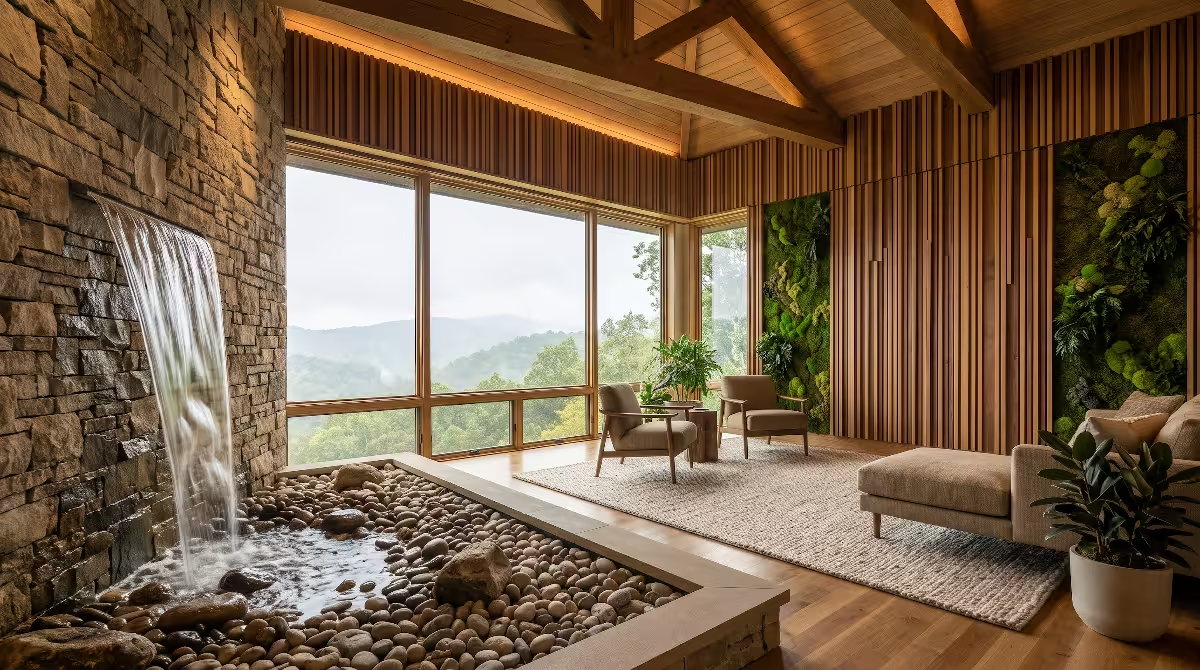
When designers talk about preserved moss walls, they rarely mean just one plant. High-end biophilic panels combine several distinct forest organisms to create depth, shadow, and natural texture that mimic an Appalachian woodland floor.
Reindeer Lichen vs. True Bryophytes
The fluffy, coral-like material seen in most modern moss walls is called reindeer moss, though it is not actually a moss at all. Its scientific name is Cladonia stellaris, and it is a slow-growing fruticose lichen formed by a partnership between a fungus and an alga. Because reindeer lichen grows in dense, spongy tufts with thousands of tiny air pockets, it excels at trapping sound waves and adding bright chartreuse or forest-green highlights to a wall.
True mosses, known to botanists as bryophytes, lack roots and vascular stems. Instead, they anchor themselves with hair-like threads and absorb moisture directly through tiny single-cell-thick leaves. Combining true mosses with reindeer lichen gives a wall panel genuine botanical realism.
Pillow Moss, Mood Moss, and Sheet Moss
Designers layer three main bryophytes to build three-dimensional moss art:
- Sheet moss (Hypnum cupressiforme): This flat, velvety green moss serves as the foundational carpet across the backing board, hiding seams and creating a smooth woodland base.
- Pillow moss (Leucobryum glaucum): True to its name, pillow moss grows in dense, rounded domes that rise two to three inches off the wall, creating soft sculptural mounds.
- Mood moss (Dicranum scoparium): Featuring longer, swept, feather-like fronds, mood moss adds wild movement and rich shadow lines between rounded pillow mounds.
By blending flat sheet moss with raised pillow and mood moss, builders create complex natural fractal patterns that immediately calm the human eye.
Acoustic Performance and Indoor Air Quality Impact
Basements are notorious for bad acoustics and stale air. Concrete floors, poured foundation walls, and flat drywall bounce sound waves back and forth, turning a basement family room or home theater into an echo chamber. Comparing living shade plants and preserved moss on sound and air performance reveals clear differences.
Sound Absorption in Hard-Surfaced Basements
Acoustic engineers measure how well a surface absorbs sound using the Noise Reduction Coefficient, or NRC, on a scale from 0.00 (total reflection, like bare concrete) to 1.00 (total absorption). A few scattered potted living shade plants on a basement floor barely move the needle on room echo, usually scoring below 0.05 NRC because their smooth leaves reflect mid-to-high speech frequencies.
Preserved moss panels, especially thick installations built with reindeer lichen and pillow moss over acoustic felt backing, perform remarkably well as sound absorbers. Laboratory tests show dense preserved moss walls reach NRC ratings between 0.40 and 0.70 across everyday human speech frequencies. Installing a preserved moss feature wall in a basement rec room or office noticeably softens harsh echoes while looking like living art.
Air Purification Myths vs. Measurable Biophilic Stress Reduction
Many homeowners buy living shade plants hoping they will scrub chemical pollutants out of basement air. This belief comes from a famous 1989 NASA study conducted inside tiny, airtight lab chambers. Modern building science has shown that in a real house, a modern HVAC system and fresh air ventilation remove volatile organic compounds, or VOCs, hundreds of times faster than houseplants ever could. You would need dozens of plants per square foot to match basic mechanical ventilation. Preserved moss, of course, performs zero air filtration because its cells are inactive.
Where both options truly shine is human psychology and stress recovery. Decades of biophilic design research prove that looking at natural greenery and organic fractal shapes lowers heart rate, reduces blood pressure, and drops cortisol levels within minutes. Even in a windowless basement, seeing healthy living shade plants or a lush preserved moss wall signals safety and vitality to the human nervous system.
Maintenance Protocols, Pest Risk, and Lifecycle Longevity
Before committing your budget, consider how much time you realistically want to spend caring for basement greenery month after month. Basement rooms are out of sight, which makes it easy to forget routine chores.
Ongoing Care Requirements: Watering, Pruning, and Dusting
Caring for living shade plants requires steady, gentle habits. Because cool basement temperatures slow down water evaporation, overwatering is the number one killer of underground plants. You should check soil moisture every ten to fourteen days with your finger or a simple moisture probe, watering only when the top layer feels dry. Twice a year during spring and summer, apply a half-strength balanced liquid fertilizer, and wipe dust off broad leaves with a damp microfiber cloth so they can capture scarce light. You also need to watch for common indoor pests like spider mites, mealybugs, and fungus gnats.
Preserved moss requires almost zero ongoing labor. You never water it, mist it, trim it, or feed it. In fact, spraying water onto preserved moss will wash out the glycerin and ruin the panel. Once or twice a year, simply blow off surface dust using a hair dryer set on its coolest, lowest fan speed or brush it lightly with a soft feather duster. Because preserved moss contains no soil, it harbors zero insects or soil pests.
Expected Lifespan and Replacement Cycles
When kept within a 20% to 50% humidity range and shielded from direct sunlight, a quality preserved moss installation lasts three to ten years or longer before its color slowly softens. Living shade plants can live for decades if they receive steady light and proper watering. However, if you place living shade plants in a dark corner without grow lights, they typically decline and need replacement within three to six months.
Upfront vs. Five-Year Total Cost of Ownership
Evaluating true value means looking at both the initial price tag and the hidden costs over five years of ownership.
Capital Expenditure Breakdown
At the register, living shade plants are far less expensive upfront. A healthy specimen ZZ plant, snake plant, or cast iron plant in a six-inch to ten-inch ceramic planter typically costs between $40 and $120. Even if you group four or five living shade plants together with sleek planters and a timer-controlled LED grow light, your initial spend usually lands between $250 and $500.
Preserved moss is a custom architectural finish, so its upfront cost is much higher. Small framed moss art pieces start around $150 to $400, while full custom preserved moss wall panels generally cost between $45 and $120 per square foot installed. A four-foot by six-foot feature wall (24 square feet) typically runs between $1,100 and $2,800 upfront.
Operational Expenditure Over Five Years
Over five years, the cost gap narrows significantly. For living shade plants, running a 25-watt LED grow light for ten hours a day adds only a few dollars a year to your electric bill, but potting soil, fertilizer, pest treatments, and replacing any plants that struggle in dim corners add ongoing expense and personal time. For commercial offices or busy homeowners who hire an interior plant service, monthly maintenance fees quickly surpass the cost of moss.
Preserved moss has virtually zero operational cost once installed, assuming you already run a dehumidifier to protect your basement from dampness. Over a five-to-eight-year window, preserved moss often delivers a lower total cost of ownership per year of effortless enjoyment.
Side-by-Side Comparison Matrix: Living Shade Plants vs. Preserved Moss
Use the comparison table below to match each option against your specific basement conditions, budget, and design goals.
| Design Factor | Living Shade Plants | Preserved Moss Installations |
| Minimum Light Needed | 50 to 100 foot-candles (10 to 20 PPFD) for 8 to 10 hours daily | Zero light required (avoid direct sunlight and UV bulbs) |
| Ideal Relative Humidity | 40% to 60% RH (tolerates wider swings) | Strictly 20% to 50% RH (absorbs moisture above 60%) |
| Routine Maintenance | Water every 10 to 21 days, dust leaves, prune, fertilize | Zero watering or pruning; gentle cool-air dusting twice a year |
| Expected Lifespan | 10+ years with proper light; 3 to 6 months if light-starved | 3 to 10+ years in climate-controlled air |
| Acoustic Absorption (NRC) | Very low (under 0.05 NRC for scattered floor pots) | Moderate to high (0.40 to 0.70+ NRC for dense moss panels) |
| Air & Moisture Exchange | Active evapotranspiration; adds light moisture in dry air | Inert material; zero oxygen production or gas exchange |
| Pest and Mold Risk | Risk of fungus gnats or root rot if potting soil stays wet | Pest-free and sterile, but prone to surface mold above 60% RH |
| Upfront vs. 5-Year Cost | Low upfront ($40 to $250 per plant); moderate ongoing care | High upfront ($45 to $120+ per sq. ft.); near-zero ongoing cost |
Biophilic Design Blueprints for Tri-Cities TN Basements
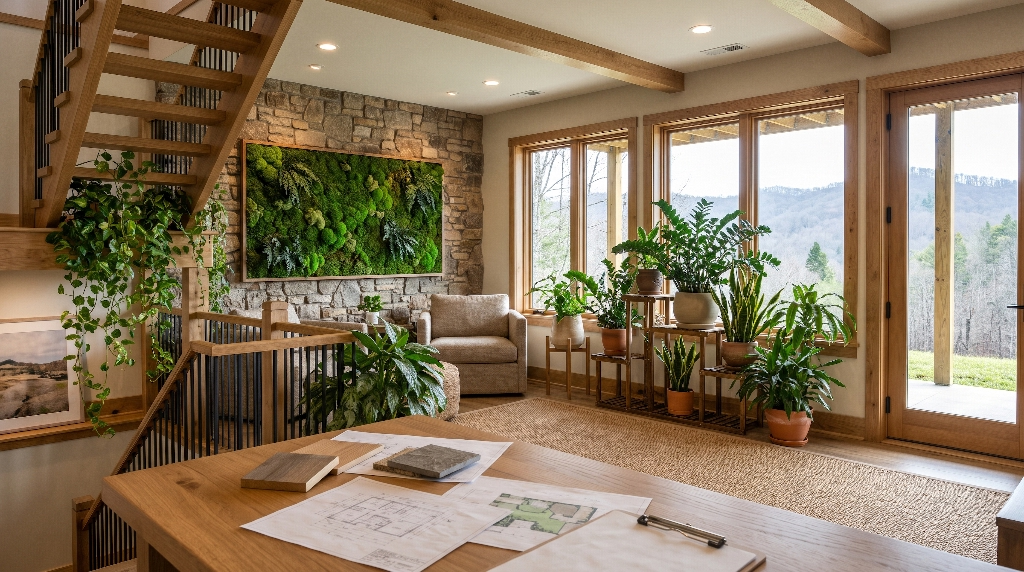
Every basement in Eastern Tennessee has its own architectural personality. Whether you own a lakeside walkout home near Boone Lake or a traditional brick ranch in Johnson City with a tucked-under foundation, you can apply three proven biophilic blueprints.
Scenario A: Daylight Walkout Basements
If your basement opens onto a patio or features full-size egress windows facing east or south, make living shade plants your primary design feature. Position a cluster of three varied planters within six to eight feet of the glass: a tall cast iron plant for vertical height, a glossy ZZ plant for mid-level structure, and a trailing jade pothos on a natural oak plant stand. Use lightweight ceramic or fiberstone pots with built-in saucers to protect basement luxury vinyl plank or engineered hardwood flooring from moisture rings.
Scenario B: Windowless Basement Media Rooms, Home Gyms, and Hallways
For completely dark interior rooms, skip the struggle of grow lights and install preserved moss wall art. In a basement home theater or workout room, mount a recessed walnut-framed preserved moss panel directly opposite the seating area or exercise equipment. Pair it with warm 2700K to 3000K recessed LED accent spotlights that cast zero ultraviolet light across the moss texture. Set a 50-pint basement dehumidifier to maintain a steady 45% relative humidity year-round so the moss stays velvety and echo-free.
Scenario C: The Hybrid Biophilic Strategy
You do not have to choose exclusively between living shade plants and preserved moss. The smartest custom basement designs combine both. Mount a bold preserved moss focal wall on a dark interior concrete partition where plumbing or electrical chases prevent windows, and place self-watering planters filled with snake plants and Chinese evergreens near the bright bottom landing of the basement stairs. This hybrid approach balances upfront budget, acoustic comfort, and authentic living growth.
Frequently Asked Questions About Basement Greenery and Living Shade Plants
Can plants survive in a basement with no natural light?
Yes, living shade plants can survive in a windowless basement, but only if you install full-spectrum LED grow lights. Plants need at least 10 to 20 PPFD of light for eight to twelve hours each day to make food. Without supplemental grow lights, even the toughest living shade plants will slowly exhaust their stored energy and die.
Does preserved moss attract mold or bugs in a basement?
Preserved moss is completely sterile and contains no soil, so it will never attract fungus gnats or indoor plant bugs. However, because the glycerin inside preserved moss pulls moisture from damp air, relative humidity above 60% can allow household mold spores to grow on its surface. Keeping a dehumidifier set around 45% prevents mold completely.
How long does preserved moss last indoors?
High-quality preserved moss lasts between three and ten years indoors, and sometimes even longer in stable environments. To maximize its lifespan, keep preserved moss away from direct window sunlight, never mist it with water, and maintain indoor humidity below 50%.
Does preserved moss clean the air like live plants?
No, preserved moss does not clean indoor air or produce oxygen. During preservation, vegetable glycerin replaces the living sap inside the plant cells, which permanently stops photosynthesis and gas exchange. Its benefits come from visual stress reduction, natural texture, and sound absorption rather than air filtration.
Is preserved moss real moss or artificial?
Preserved moss is 100% real moss and lichen harvested from nature, not plastic or silk artificial greenery. Technicians treat real harvested bryophytes with non-toxic vegetable glycerin and natural pigments so they retain their soft feel, natural scent, and organic shape for years without growing.
Does preserved moss have a smell, and is it safe for pets?
Freshly unboxed preserved moss often has a mild, earthy forest scent mixed with a faint sweet note from the vegetable glycerin. This natural aroma fades within a few days to two weeks in a ventilated room. While non-toxic preservation solutions are safe around homes, preserved moss is not edible, so mount panels out of reach of curious cats and dogs.
What are the best low-light plants for a basement without grow lights?
If your basement has at least one egress window or glass door providing dim indirect daylight, the best living shade plants are the ZZ plant, cast iron plant, snake plant, Chinese evergreen, and jade pothos. These hardy species store energy efficiently and tolerate deep shade far better than flowering or variegated houseplants.