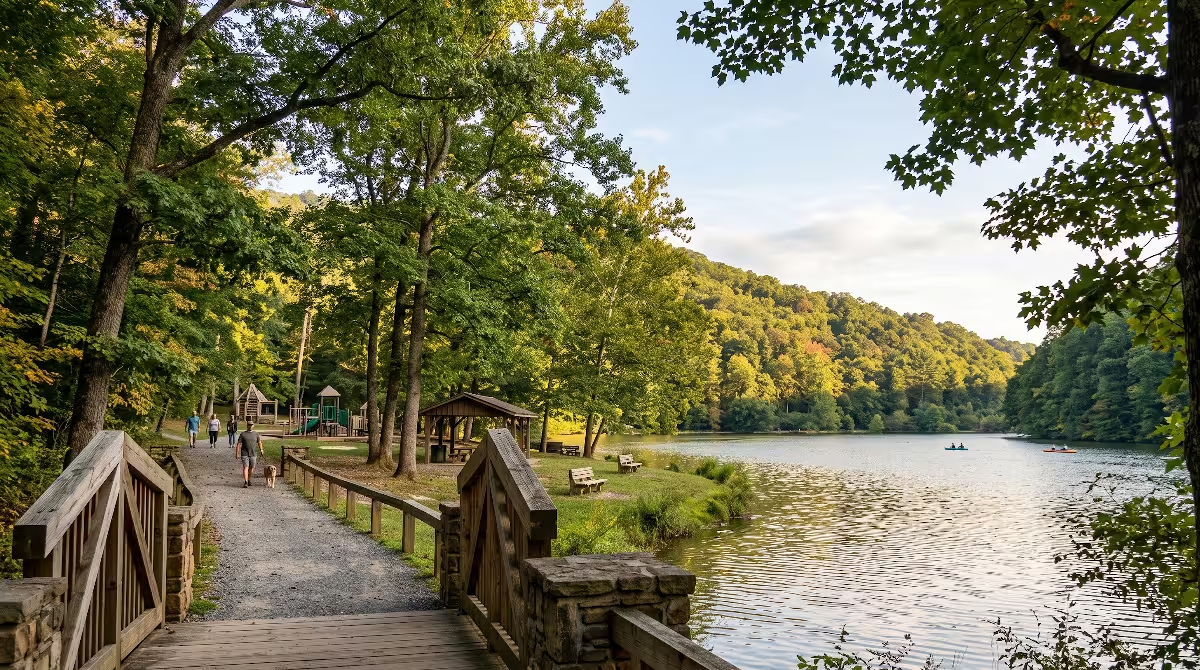


Offices across Johnson City, Kingsport, and Bristol are changing. Many companies in the Tri-Cities area have left behind closed cubicles to build open, collaborative workspaces. They choose exposed brick, timber beams, and high ceilings. These spaces look beautiful and feel open, but they bring a serious engineering problem. Sound bounces off hard surfaces, and conversations travel across the entire floor.
When employees cannot focus because of nearby chatter, companies often look for a quick fix. Traditionally, commercial builders installed electronic sound systems in the ceiling to pump out artificial static or white noise. Today, biophilic design offers a more effective, human-centered choice. By using natural sound masking, office designers can solve noise distractions using natural elements like flowing water and living plant walls.
Understanding natural sound masking compared to electronic white noise is essential for any office planner in East Tennessee. This guide explores the acoustic physics, human biology, mechanical engineering, and regional climate factors that make natural sound masking a superior design strategy for modern workplaces.
The Physics of Workplace Distraction: Speech Privacy vs. Noise Pollution

To fix acoustic problems in an office, we must first look at how sound travels through indoor spaces. Many managers think the main problem in an open office is general noise volume. In reality, overall volume is rarely the issue. The real issue is speech intelligibility, which is how easily someone can understand the words of a conversation they are not part of.
Human brains are hardwired to process spoken language. When a coworker speaks fifteen feet away, your brain cannot simply ignore the words. It burns mental energy trying to follow the conversation. This breaks your focus and interrupts deep thinking.
The Mechanics of Speech Intelligibility
Acoustical engineers measure this problem using two standard metrics: the
- A score of 1.0 means every single syllable is clear and understandable.
- A score below 0.20 means speech is completely unintelligible, turning voices into harmless background sound.
Speech Transmission Index (STI) Impact on Focus:
0.00 to 0.20: Complete Speech Privacy (Working memory protected)
0.21 to 0.49: Transitional Privacy (Occasional words recognized)
0.50 to 1.00: High Intelligibility (Severe cognitive distraction)
In an untreated open room, the Speech Transmission Index often sits between 0.60 and 0.80. This creates a wide radius of distraction. The radius of distraction is the distance around a person where outside speech remains clear enough to ruin concentration. In an untreated room, that radius can easily reach forty-five feet.
The goal of natural sound masking is to raise the ambient background level just enough in specific speech frequencies to cut this radius down to twelve or fifteen feet. By using natural sound masking, you cover the consonant sounds of human speech without making the room uncomfortably loud.
Radius of Distraction (rD) Comparison:
Untreated Open Office Space:       [---------------- 45 Feet ----------------]
Standard Electronic White Noise:   [--------- 22 Feet ---------]
Engineered Natural Sound Masking:  [----- 12 to 14 Feet -----]
Frequency Disparity Between Synthetic Signals and Water
Not all background sound works the same way. Sound moves in waves, and different sounds have different amounts of energy across low, mid, and high frequencies.
Electronic white noise spreads sound energy equally across every audible frequency from 20 Hertz to 20,000 Hertz. Because human hearing is very sensitive to higher pitches, raw electronic white noise sounds like an annoying, sharp hiss. It resembles television static or a steam valve leaking. Because it has too much high-frequency energy, facilities teams have to turn the volume up to 65 or 70 decibels to cover conversations. That volume is much too loud for daily office work.
Engineered electronic masking systems use pink noise instead of pure white noise.
Natural sound masking uses running water and moving air to produce acoustic energy across the exact same speech bands. Instead of an artificial digital loop, natural sound masking creates a rich, natural sound spectrum known as fractal noise. The volume rises and falls in subtle, gentle ways.
Because natural sound masking distributes acoustic power naturally, it covers human speech at comfortable volume levels of 45 to 48 decibels. You get effective speech privacy without blasting synthetic static into the room.
Psychoacoustics and Biology: Why Electronic Hiss Drains Cognitive Capital
Sound is not just a physical wave that hits your eardrum. It is also an electrical signal that your brain interprets. Psychoacoustics is the study of how human beings respond psychologically and physically to different sounds. This is where electronic white noise and natural sound masking lead to completely different workplace outcomes.
Auditory Habituation vs. Neurological Load
Your ears never sleep, and they never turn off. Even when you are deeply focused on a spreadsheet or a design document, your auditory system constantly scans your environment for threats.
When an office uses electronic sound masking speakers, the sound is completely uniform, unchanging, and synthetic. The brain attempts a process called auditory habituation, which means it tries to tune out the constant noise.
Because electronic sound lacks natural variation, the brain must spend energy actively suppressing the sound. This constant background effort creates neurological fatigue. Workers at desks beneath electronic speakers often report:
- Dull tension headaches by mid-afternoon
- Irritability and low patience during meetings
- Mental exhaustion that feels worse than their actual workload
Synthetic noise can also trigger the Lombard Effect. This is an involuntary human behavior where people talk louder to make themselves heard over artificial hums. When electronic masking is too loud, workers talk over it, making the office louder and more stressful.
Natural sound masking avoids this problem entirely. Because water sounds match what humans evolved to hear over millions of years, the brain accepts the sound immediately. The brain does not treat natural sound masking as a warning signal or an annoying hum. As a result, natural sound masking provides acoustic privacy without tiring out your staff.
Attention Restoration Theory and Biomorphic Soundscapes
In environmental psychology, Attention Restoration Theory explains how natural environments heal mental fatigue. Psychologists divide human attention into two types:
- Directed Attention: This is the focused mental energy you use to write code, review contracts, crunch numbers, or solve complex problems. Directed attention takes real effort and drains your mental reserves.
- Soft Fascination: This happens when you experience natural movement, like clouds drifting across the sky, leaves fluttering in the wind, or water trickling down stone. Soft fascination catches your attention effortlessly without draining your mental energy.
Natural sound masking creates an acoustic version of soft fascination. The random variations in water droplets create a rich acoustic texture. This gentle pattern lets the prefrontal cortex rest while people work.
Studies measuring worker physiology show clear physical differences between these sound environments. People working around natural sound masking show lower baseline heart rates, improved heart rate variability, and lower skin conductance levels. These markers prove that natural sound masking calms the sympathetic nervous system.
Electronic white noise keeps the body in a low-grade state of alert. Natural sound masking keeps the body calm and focused.
Biological Response Comparison:
Acoustic Factor           Electronic Masking            Natural Sound Masking
Autonomic Response        Elevated alert state          Calm, balanced state
Cortisol Impact           Slow, steady increase         Lower baseline levels
Mental Fatigue            High after 4 hours            Low throughout full shift
Acoustic Acceptance       Often viewed as annoying      Viewed as pleasant amenity
Natural Sound Masking Systems: Engineering Nature Indoors
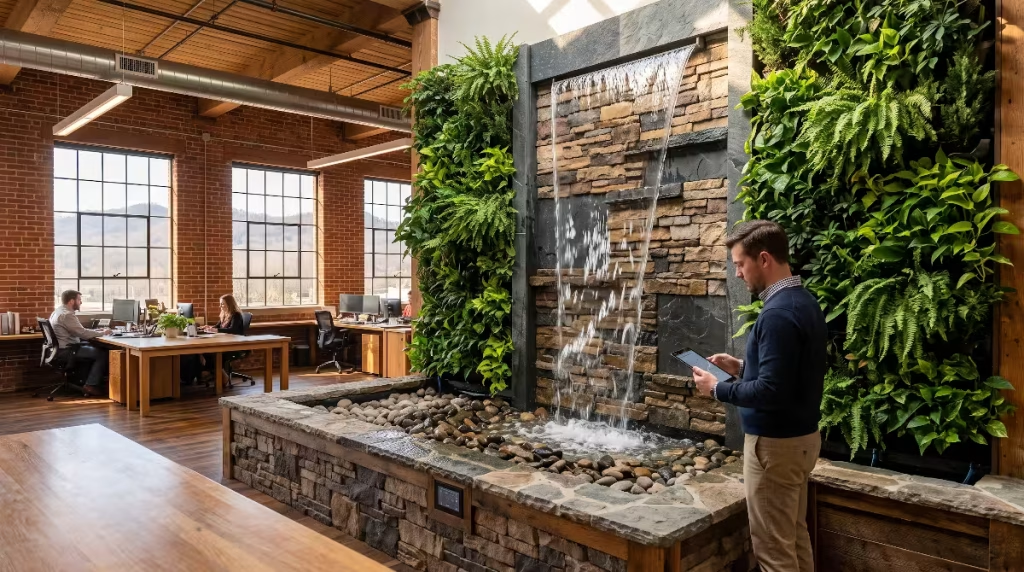
Using natural sound masking in an office requires careful engineering. You cannot just place a small tabletop fountain in the corner and expect it to cover speech. A decorative fountain creates isolated splashes that do not distribute sound evenly. To achieve true speech privacy, natural sound masking must be built into the architectural fabric of the room.
Water Features as Tunable Acoustic Transducers
In professional biophilic design, an indoor water wall acts as an acoustic transducer. It turns hydraulic energy into acoustic energy across targeted frequency bands. Designers can tune natural sound masking by adjusting four mechanical factors:
Water Feature Tuning Variables:
1. Fall Height: Distance water travels before striking the basin pool
2. Surface Texture: Smooth glass, grooved slate, stacked shale, or copper mesh
3. Flow Rate: Gallons per minute pumped across the weir surface
4. Basin Depth: Water level and absorption baffles in the lower capture tank
To mask human speech, the water feature must generate sound between 250 Hertz and 2,000 Hertz. This is where vowel and consonant sounds travel.
If water flows as a smooth, sheet-like film down glass, it produces very little sound. It looks nice, but it generates almost no natural sound masking.
If water drops freely from a high ledge into open water, it creates low-frequency thumps and high-pitched splashing. That can be too loud for workers sitting nearby.
The best approach uses a textured surface, such as split-face Tennessee fieldstone, slate, or fluted ceramic panels. As water travels down the uneven surface, it breaks into micro-droplets and small streams. The continuous impact of water against stone creates a broad acoustic spectrum.
By adjusting water pumps with variable frequency drives, facilities teams can adjust the sound volume. On busy Tuesday mornings when the office is full, the pump speed can rise slightly to increase natural sound masking. On quiet Friday afternoons, the flow can slow down to keep the space peaceful.
Frequency Spectrum Breakdown for Water Feature Tuning:
Frequency Range   Acoustic Goal             Engineering Adjustment
125 to 250 Hz     Gentle low rumble         Adjust basin depth to prevent booming
500 to 1,000 Hz   Vowel sound masking       Use textured stone to create steady flow
1,000 to 2,000 Hz Consonant masking         Create small water breaks and micro-falls
4,000 to 8,000 Hz Crisp high end            Keep minimal to avoid piercing hiss
Vegetated Acoustic Buffers and Living Walls
Water is only half of an effective natural sound masking installation. The other half is sound absorption. If you add water sound to a room with concrete floors, glass windows, and bare drywall, the sound will bounce around and create an echo chamber.
To keep sound under control, designers pair water walls with living plant walls. A well-designed living wall serves as a broadband sound absorber. It absorbs reflected sound across a wide range of frequencies:
- The Growing Medium: The soil, felt pads, or porous volcanic stone used in living walls absorb low frequencies from 100 Hertz to 400 Hertz. These low frequencies are usually very hard to control with standard drywall.
- The Foliage: Plant leaves scatter and diffuse mid and high frequencies between 500 Hertz and 4,000 Hertz. Instead of bouncing cleanly off a flat wall, sound waves scatter in many directions when they hit plant leaves, losing their energy.
Living Wall Sound Absorption (NRC Comparison):
Standard Painted Drywall:      [== 0.05 NRC (Reflects 95% of sound) ]
Standard Commercial Carpet:    [====== 0.25 NRC                     ]
Acoustic Ceiling Tile:         [================ 0.70 NRC           ]
Engineered Living Plant Wall:  [==================== 0.85 NRC       ]
When you combine a living wall with an indoor water feature, you create a balanced acoustic environment. The water feature provides pleasant natural sound masking to cover conversations. The living wall soaks up unwanted echoes and prevents the room from getting noisy. Together, they create a balanced soundscape that protects speech privacy while keeping the room calm.
Technical Comparison: Electronic Systems vs. Biophilic Installations
When evaluating natural sound masking against electronic sound systems, commercial real estate teams must look at performance, health benefits, and operational costs.
| Evaluation Metric | Direct-Field Electronic Masking | Plena-Mounted In-Ceiling Masking | Natural Sound Masking (Water & Plant Walls) |
| Primary Sound Source | Downward ceiling speakers | Speakers bouncing sound off roof deck | Engineered water cascades and living foliage |
| Frequency Profile | Calibrated electronic pink noise | Indirect electronic pink noise | Stochastic fractal 1/f pink-brown distribution |
| Acoustic Decibel Range | 45 to 48 dB(A) | 46 to 50 dB(A) | 44 to 48 dB(A) (Fully tunable) |
| Speech Privacy Rating (STI) | Achieves STI less than or equal to 0.20 | Achieves STI less than or equal to 0.22 | Achieves STI less than or equal to 0.20 within 14 feet |
| Cognitive Fatigue Impact | Moderate fatigue over 8 hours | Low to moderate fatigue | Restorative; lowers cortisol and mental fatigue |
| Spatial Localization | Pinpointed if ceiling is low | Diffuse, but feels artificial | Visually anchored and naturally accepted |
| Energy Consumption | Low (continuous electrical draw) | Low (continuous electrical draw) | Low to moderate (pumps, LED grow lights) |
| Indoor Air Quality (IAQ) | No impact | Can shake loose ceiling dust | Adds humidity, filters dust, produces oxygen |
| Maintenance Needs | Annual software checks | Occasional speaker replacement | Bi-weekly water checks and plant maintenance |
| Tenant Appeal | Purely utility infrastructure | Purely utility infrastructure | Premium architectural amenity |
Analysis of Long-Term Operating Variables
Electronic systems have lower initial installation costs and need very little day-to-day care. A contractor mounts speakers in the ceiling, pulls wiring to a central server rack, tunes the frequencies, and hands over the controls.
However, electronic systems provide no extra value beyond sound coverage. They do not clean the air, they do not make the room look better, and they often cause employee complaints when workers feel fatigued by synthetic noise.
Natural sound masking requires higher initial planning and plumbing considerations. Yet, natural sound masking delivers returns across several building systems:
- Better Indoor Air Quality: Plants in living walls absorb carbon dioxide and release fresh oxygen. They also capture airborne dust particles on their leaves.
- Humidity Regulation: In winter, heated office air gets dry. Water walls naturally humidify the air, making the room more comfortable and reducing winter static shocks.
- Valuable Amenity: An office with a stunning stone water wall and lush green plants looks upscale. It helps attract and keep top talent in competitive hiring markets.
East Tennessee Regional Specifics: Climate, Architecture, and Geology
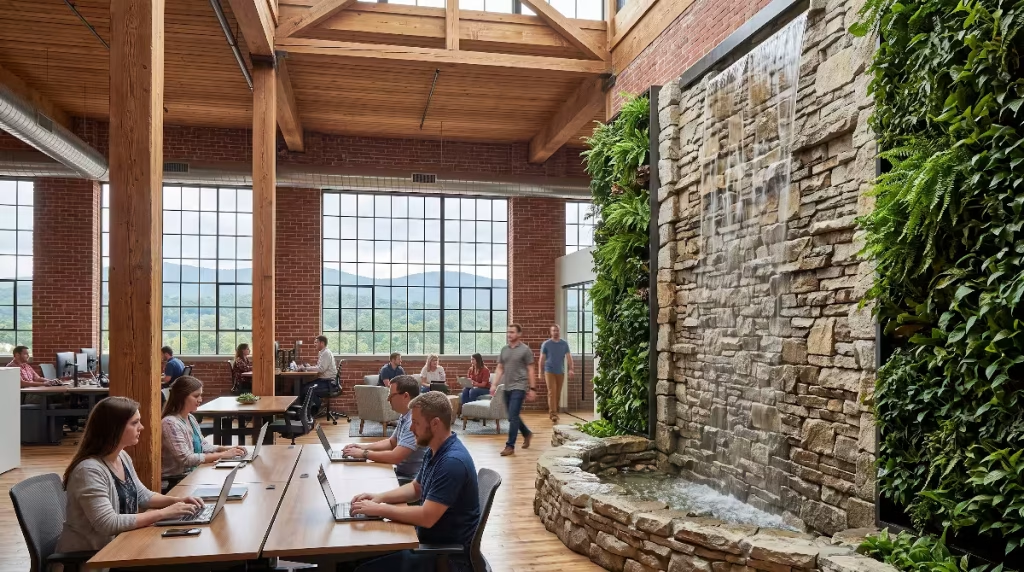
Every region has unique architecture, weather, and water chemistry that affect building design. Applying natural sound masking in the Tri-Cities area of East Tennessee requires an understanding of our local environment.
East Tennessee Regional Factors for Acoustic Design:
1. Architecture: Converted industrial brick-and-timber textile mills and railway hubs
2. Climate: Humid subtropical summers with dry, heated mountain winters
3. Geology: Karst topography with mineral-rich hard limestone groundwater
The Tri-Cities Building Typology
The commercial real estate landscape in East Tennessee is distinct. Downtown Johnson City, Kingsport, and Bristol feature historic brick-and-beam industrial spaces, former furniture factories, and old rail warehouses that are being converted into modern workplaces. We also have modern medical office complexes tied to the regional healthcare systems, along with corporate technology outposts.
Converted historic buildings present major acoustic hurdles:
- Hard, Highly Reflective Surfaces: Restored heart-pine timber floors, exposed multi-wythe brick walls, and open structural iron trusses cause sound to bounce repeatedly.
- Long Reverberation Times: In an untreated historic space, reverberation time, or RT60, can easily exceed 1.5 to 2.0 seconds. For clear, comfortable speech, an office needs an RT60 between 0.5 and 0.7 seconds.
Reverberation Time (RT60) in Converted Historic Spaces:
Untreated Industrial Mill Conversion:   [==================== 1.85 Seconds ]
Treated with Carpet and Acoustic Foam:  [=========== 1.10 Seconds           ]
Treated with Living Walls & Water Wall: [====== 0.58 Seconds                ]
Target Ideal Commercial Standard:       [====== 0.60 Seconds                ]
Installing ceiling speakers in spaces with thirty-foot timber ceilings often fails. The synthetic sound bounces off the hard brick and timber, creating an irritating hiss that fills the entire room.
Natural sound masking solves this problem much better. A central water wall provides local acoustic masking at floor level where workers sit. At the same time, large living walls absorb sound bouncing off the brick. This pair drops reverberation times back down to comfortable levels, preserving the historic charm while fixing the acoustic problems.
Environmental and Mechanical Integration in Southern Appalachia
The Southern Appalachian mountain climate brings specific seasonal challenges that affect how mechanical systems interact with natural sound masking:
Relative Humidity Management
Summers in East Tennessee are humid, while winter mountain air is cold and dry. When office heating runs during freezing winter days, indoor relative humidity can drop below 20%. This dry air dries out skin, irritates eyes, and helps viruses spread.
An engineered water feature acts as a natural evaporative humidifier during cold months. It helps maintain indoor humidity within the healthy 40% to 60% range recommended by ASHRAE standards.
During humid summer months, commercial HVAC systems remove moisture from the air. To prevent water features from overloading the air conditioning, natural sound masking systems use automated cooling loops. These loops chill the reservoir water slightly, reducing evaporation while maintaining excellent sound masking performance.
Karst Geology and Hard Water Management
The Tri-Cities area sits on a limestone karst geological valley. Well water and municipal water lines in Sullivan, Washington, and Carter counties contain high levels of dissolved calcium and magnesium carbonate.
If you run hard tap water through a natural sound masking water feature, problems happen quickly:
- White mineral scale builds up on dark slate and stone panels.
- Nozzles and flow pipes clog up over time.
- Mineral crusting changes the texture of the stone surface, ruining the tuned sound frequencies of the water cascade.
Water Filtration Flow for Tri-Cities Acoustic Systems:
Municipal Supply Line -> 5-Micron Sediment Filter -> Carbon Block -> Reverse Osmosis Membrane -> Sealed Storage Reservoir -> UV Sterilization Loop -> Tuned Acoustic Water Cascade
To protect natural sound masking installations in East Tennessee, the system must include dedicated reverse osmosis filtration. Using purified water prevents mineral scale from forming. The stone stays clean, the pumps run reliably, and the natural sound masking retains its precise frequency balance for years.
Hybrid System Design: The Pragmatic Engineering Compromise
While natural sound masking offers great health and acoustic benefits, commercial facilities must balance ideal biophilic design with real-world budget constraints.
In large corporate spaces, the best design choice is often a hybrid approach. This strategy uses natural sound masking as the primary acoustic feature in main collaboration areas, supported by quiet electronic systems in private rooms where privacy laws require absolute speech masking.
The Zoned Acoustic Gradient Architecture
A zoned acoustic gradient designs sound based on how each room is used, rather than applying a single sound level across the whole floor.
Zoned Acoustic Gradient Architecture:
+-------------------------------------------------------------------------+
| ZONE A: Public Atrium & Entrance                                        |
| Primary: Monumental Natural Sound Masking (Water wall & living wall)    |
| Target: 48 to 50 dB(A) | Restorative Biophilic Welcome                  |
+-------------------------------------------------------------------------+
                                    |
                                    v
+-------------------------------------------------------------------------+
| ZONE B: Open-Plan Workstation Neighborhoods                             |
| Primary: Localized Natural Sound Masking Water Panels                   |
| Secondary: Low-voltage tuned pink emitters in peripheral pathways       |
| Target: 45 to 47 dB(A) | Low radius of distraction                      |
+-------------------------------------------------------------------------+
                                    |
                                    v
+-------------------------------------------------------------------------+
| ZONE C: Executive Boardrooms, Legal Suites, & HR Offices               |
| Primary: In-Plenum Electronic Masking (Constant STC reinforcement)     |
| Secondary: Silent moss wall panels for acoustic absorption              |
| Target: 42 to 44 dB(A) | Regulatory speech compliance                   |
+-------------------------------------------------------------------------+
Zone A: Public Atriums, Receptions, and Main Entrances
This area creates the first impression for visitors, clients, and employees. Here, facilities teams should use monumental natural sound masking.
A large, two-story water wall combined with lush living walls sets a peaceful biophilic tone. The water masks footsteps, elevator dings, and exterior street noise. It creates a welcoming transition between the outside world and the productive office inside.
Zone B: Open-Plan Workstation Neighborhoods
This zone houses most employee desks, computer bays, and collaborative team tables. Here, designers install mid-sized natural sound masking water features integrated into room dividers and storage walls.
These modular water walls are placed every thirty to forty feet. They break open spaces into smaller, comfortable acoustic neighborhoods.
If workstations extend far from the water features, low-voltage electronic speakers can provide gentle background masking along outer corridors. This hybrid setup ensures even sound coverage across the entire floor.
Zone C: Executive Boardrooms, Legal Suites, and HR Offices
Private offices require strict speech confidentiality. Corporate legal rooms, medical examination rooms, and human resource offices must meet strict legal privacy standards, such as HIPAA rules.
In these closed rooms, variable water flow may not guarantee the constant sound level required by privacy laws.
Here, facilities teams install dedicated electronic masking speakers inside the ceiling plenum. These speakers are paired with static, preserved moss wall panels for sound absorption. This approach keeps confidential conversations private without placing synthetic noise in common areas where it causes fatigue.
Acoustic Design and Natural Sound Masking Questions Answered
Does sound masking really work in an open office?
Yes, sound masking works very well in open offices, but not by making the room silent. A common myth is that sound masking cancels sound like noise-canceling headphones. It does not. Instead, sound masking works by reducing the signal-to-noise ratio between a speaker and a listener.
When an office is completely silent, the background sound level drops to 30 or 35 decibels. In a room that quiet, you can hear a whisper forty feet away. Every keyboard click, chair scrape, and cough becomes a distraction.
Sound masking raises the ambient background sound to a comfortable 45 to 48 decibels. When speech volume and background noise are nearly equal, the human brain can no longer decipher the words.
Natural sound masking achieves this balance without using synthetic static. By introducing gentle water sounds, natural sound masking covers conversations, reduces distractions, and keeps the room comfortable.
Can a fountain replace commercial sound masking?
A simple decorative fountain bought at a garden center cannot replace commercial sound masking. Standard fountains are built for appearance, not acoustics. They often create point-source splashing sounds that do not mask speech properly:
- The water sounds are localized to one small spot.
- The splashing frequency is often too high, creating an annoying drip rather than a broad sound spectrum.
- Small fountains do not generate enough acoustic energy to cover the 250 Hertz to 2,000 Hertz speech bands.
To work effectively, a water feature must be custom engineered for natural sound masking. This requires calculating water flow rates, selecting textured stone surfaces, and designing water collection basins with acoustic absorption.
When properly engineered, a biophilic water installation delivers acoustic coverage that matches commercial electronic systems, while looking and feeling much better.
Decorative Fountains vs. Engineered Acoustic Water Walls:
Design Feature       Decorative Garden Fountain      Engineered Acoustic Water Wall
Acoustic Spectrum    Uncontrolled splashing          Tuned speech-frequency coverage
Decibel Output       Fluctuates wildly               Calibrated between 45 and 48 dB(A)
Coverage Area        3 to 5 foot radius              30 to 45 foot acoustic zone
Visual Integration   Standalone table item           Built into walls and architectural flow
Filtration System    Basic pump filter               Multi-stage reverse osmosis and UV
Which is better for speech privacy: white noise, pink noise, or running water?
To compare these options, we must examine their frequency curves and how the human ear responds to them:
- White Noise: White noise has equal energy across all frequencies. Because our ears hear high frequencies very well, white noise sounds like an unpleasant, sharp hiss. It is rarely used in modern offices because it quickly causes headaches and fatigue.
- Pink Noise: Pink noise reduces high frequencies by three decibels per octave, creating a deeper, more balanced sound. Most electronic ceiling systems use tuned pink noise. It masks speech well, but it is still a synthetic, artificial sound that can feel unnatural over a full workday.
- Running Water: Running water generates a natural fractal sound curve that mimics pink and brown noise naturally. Because it is non-repeating and organic, human brains accept it without strain.
For speech privacy, running water used in natural sound masking is the best choice. It provides speech coverage equal to pink noise, avoids the harshness of white noise, and lowers stress for employees.
What are the acoustic standards for WELL and LEED in Tennessee offices?
Both the WELL Building Standard and LEED rating systems reward commercial projects that design healthy, comfortable acoustic environments.
Green Building Certification Frameworks for Acoustics:
+------------------------------------------------------------------------+
| WELL Building Standard v2: Sound Concept                               |
| - Feature S01: Sound Mapping (Mandatory acoustic zoning)               |
| - Feature S02: Maximum Noise Levels (Limits mechanical HVAC noise)     |
| - Feature S03: Sound Absorption (High NRC ratings via living surfaces) |
| - Feature S04: Sound Masking (Encourages biophilic acoustic sources)   |
| - Feature S05: Enhanced Speech Privacy (STI values under 0.20)         |
+------------------------------------------------------------------------+
                                    +
+------------------------------------------------------------------------+
| LEED v4.1 for Interior Design and Construction (ID+C)                  |
| - Acoustic Performance Credit (1 to 2 Points Available)                |
|   * Keeps HVAC background noise under 40 dBA in private offices        |
|   * Sets reverberation times (RT60) under 0.6 seconds in open areas    |
|   * Requires Sound Transmission Class (STC) ratings above 45 to 50     |
+------------------------------------------------------------------------+
Using natural sound masking helps projects earn credits across multiple green building categories:
- It satisfies sound masking and privacy requirements under WELL Feature S04 and S05.
- The living plant walls contribute to sound absorption under WELL Feature S03 and LEED Acoustic Performance credits.
- The living plants and
water features contribute to Biophilia requirements under the WELL Mind and Air concepts, as well as LEED indoor environmental quality credits.
Implementation Guide and Commissioning Checklist for Facilities Managers
Installing natural sound masking in a new or renovated commercial space requires a clear, step-by-step process. Facilities teams and architects should follow this commissioning checklist to ensure success.
Natural Sound Masking Project Roadmap:
Phase 1: Baseline Site Acoustic Survey (Measure ambient dBA and RT60 times)
   |
Phase 2: Architectural & Hydraulic Design (Tune stone textures and flow rates)
   |
Phase 3: MEP & Water System Prep (Install reverse osmosis, drain, and power)
   |
Phase 4: Physical Installation (Mount water panels, plant arrays, and lighting)
   |
Phase 5: Acoustic Commissioning & Tuning (Verify STI and adjust pump speeds)
   |
Phase 6: Long-Term Maintenance Plan (Bi-weekly water checks and plant care)
Step 1: Pre-Design Acoustic Survey
Before specifying equipment, conduct an acoustic audit of the empty or existing space:
- Measure Ambient Sound Floor (L90): Record the background noise level when the room is empty. This shows the baseline noise created by your HVAC system and outdoor traffic.
- Measure Reverberation Time (RT60): Use a sound meter and an acoustic starter pistol or balloon pop to measure how long sound echoes in the room. If RT60 is above 0.8 seconds, you must add sound absorption, such as living walls or acoustic ceiling baffles, before installing sound masking.
- Map Traffic Paths: Identify primary walkways, breakout lounges, and quiet focus zones to lay out your acoustic gradient.
Step 2: Mechanical, Electrical, and Plumbing (MEP) Preparation
Natural sound masking systems require simple, reliable mechanical connections:
- Plumbing Lines: Install a half-inch dedicated cold water supply line fitted with a shutoff valve. Connect the line to a four-stage reverse osmosis filtration system.
- Drain Lines: While high-end water features use closed-loop recirculating tanks, install a one-inch emergency overflow drain tied directly to your building waste lines.
- Electrical Needs: Provide a dedicated 120-volt, 20-amp electrical circuit with ground fault circuit interruption protection. This powers the variable-speed water pumps, UV sterilizers, and automated filling valves.
- HVAC Coordination: Position water features away from direct high-velocity HVAC air supply diffusers. Strong air currents can cause water droplets to drift and disturb the smooth water flow down the stone surface.
Step 3: Installation and Acoustic Commissioning
Once the water wall and living walls are installed, tune the natural sound masking system to match the room:
- Initial Water Fill: Fill the reservoir with reverse osmosis water and turn on the UV filtration loop.
- Calibrate Flow Rates: Adjust the variable-frequency drive on your water pump. Start at a low flow rate and slowly increase speed until the water covers the entire stone face without splashing onto the floor.
- Decibel Spectrum Verification: Place a Type 1 sound level meter twelve feet away from the water feature at seated ear height (about forty-eight inches off the floor). Measure the sound across 1/3-octave frequency bands:
- Check that overall volume sits between 45 and 48 dB(A).
- Verify that frequencies between 250 Hertz and 2,000 Hertz show a smooth, downward-sloping curve without harsh spikes.
- Speech Privacy Verification: Have two team members talk in normal voices ten to twelve feet away from the workstation. Confirm that the words are muffled and that the Speech Transmission Index drops below 0.25.
Step 4: Maintenance Protocols for Facility Teams
To keep a natural sound masking system running smoothly, follow this simple maintenance schedule:
Preventative Maintenance Schedule:
Every Week:
- Check water reservoir levels and auto-fill float valves.
- Inspect living wall soil moisture and irrigation timers.

Every Month:
- Test reverse osmosis water purity using a TDS (total dissolved solids) meter.
- Inspect and clean pump intake screens.
- Prune dead leaves from living walls to encourage dense plant growth.

Every Quarter:
- Replace pre-filters on the reverse osmosis water filtration system.
- Check and clean UV sterilization quartz sleeves.
- Measure sound decibel levels to ensure pump speeds have not shifted.

Every Year:
- Replace reverse osmosis membranes.
- Replace UV sterilization lamps.
- Perform a complete acoustic review of the office to account for desk changes.
Creating Human-Centered Workplaces in East Tennessee
Creating a productive, quiet workspace does not require filling your ceilings with synthetic electronic white noise. For companies across the Tri-Cities, natural sound masking provides an innovative, healthy alternative that combines acoustic engineering with biophilic design.
By using engineered water walls and living plants, facilities teams can lower speech distractions, reduce mental fatigue, and create inviting workspaces. Natural sound masking transforms an office from a noisy room into a calm, productive environment.
Whether you are restoring a historic brick mill in downtown Johnson City, designing a corporate headquarters in Kingsport, or opening a technology center in Bristol, natural sound masking offers a smart balance of physics and design. It protects speech privacy, supports employee wellness, and builds workplaces where people love to work.