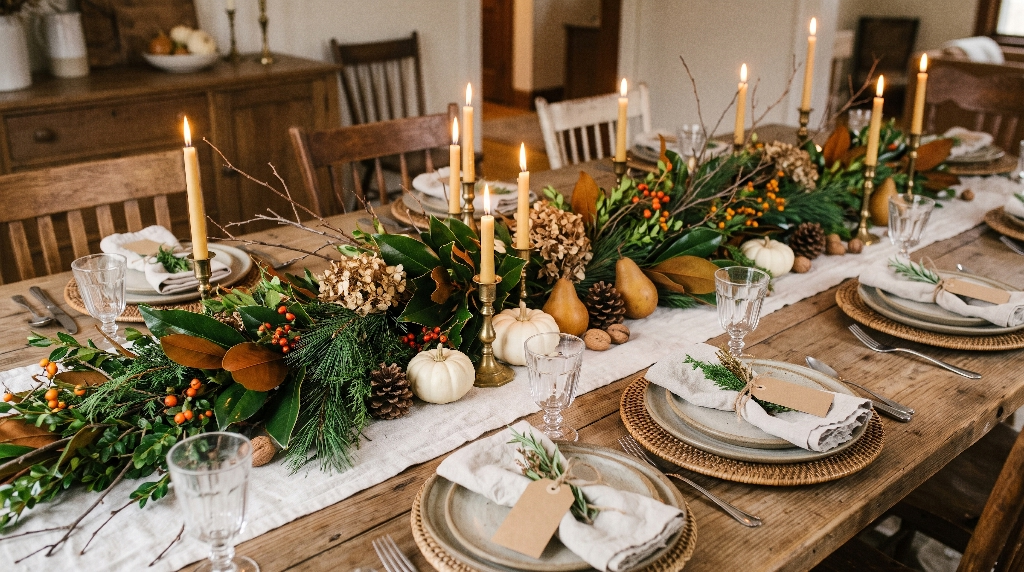

Every November, hosts across the country face the same quiet tug of war in the dining room. You want your Thanksgiving table to look thoughtful, warm, and worthy of a special holiday meal, yet you do not want your family and friends to feel like they are eating inside a museum. Traditional stiff tablecloths often create that exact problem. Heavy starched cotton or slippery polyester cloths demand constant smoothing, catch on belt buckles, and make guests panic the second a drop of cranberry sauce threatens to fall. Replacing that rigid cover with a vintage stonewashed linen table runner for Thanksgiving changes the entire mood of the room before the first dinner roll is even passed.
There is real psychology behind how a table feels to the people gathered around it. When you lay down soft, supple stonewashed linen, the tactile warmth of the fabric immediately lowers the formality barrier. Guests notice the gentle texture under their forearms and the relaxed, lived-in drape at the ends of the table. Instead of sitting upright and worrying about ruining a pristine white banquet cloth, people lean in, pass platters freely, and settle into real conversation. A great holiday table should invite connection, and stonewashed linen carries an effortless grace that makes everyone feel welcome.
From a home design and carpentry perspective, a runner also does something a full tablecloth never can. Most dining tables are built from beautiful solid hardwoods like white oak, black walnut, cherry, or reclaimed pine. Covering that entire surface hides the natural wood grain and craftsmanship that anchor the dining room. Running a strip of textured stonewashed linen down the center frames the wood rather than hiding it. The warm timber glows on either side of the fabric, creating architectural depth and balance that feels both grounded and elevated.
In this guide, we will walk through everything you need to know to choose, size, style, and care for a vintage stonewashed linen table runner for Thanksgiving. You will learn how authentic European flax is transformed into soft stonewashed linen, how to calculate the exact overhang math for your specific dining table, and how to layer earthy autumn colors with stoneware and candlelight. We will also cover practical sightline rules for centerpieces, foolproof methods for removing gravy, red wine, and candle wax, and smart storage habits that keep your heirloom runner fresh for decades of family gatherings.
The Craft Behind the Textile: European Flax, Stonewashing, and Vintage Patina
Not all linen on the market is created equal, and knowing how the fabric is grown and finished will save you from buying a stiff, scratchy imitation. When you shop for authentic stonewashed linen, you are looking at one of the oldest and strongest natural textiles in home history. Understanding the raw fibers and finishing steps helps you spot true quality right away.
Why Long-Staple European Flax Outlasts Synthetic Blends
Real linen comes from the stalks of the flax plant, and the finest flax in the world grows along the coastal regions of Western Europe, particularly in France, Belgium, and the Netherlands. The cool, damp climate and rich soil in these areas allow the flax plants to grow tall and straight. Taller stalks produce long-staple fibers, which are smooth, strong, and far less likely to pill or fray over time than short fibers.
Many budget runners sold online mix a small amount of linen with cotton, rayon, or polyester. Those synthetic blends might look similar in a quick product photo, but they behave very differently on a Thanksgiving table. Polyester traps heat, holds onto grease stains, and develops a shiny, artificial sheen after a few washes.
By contrast, pure European flax breathes naturally, absorbs moisture without feeling damp, and actually grows stronger when it gets wet. Investing in 100 percent flax stonewashed linen gives you a table piece that improves with age rather than wearing out.
What Stonewashing Actually Does to Raw Linen Fibers
Freshly woven raw linen can feel crisp, heavy, and slightly stiff straight off the loom. In past generations, families had to wash and line-dry a new linen cloth dozens of times before it developed that buttery, broken-in drape. Modern stonewashing accomplishes that gentle aging process before the runner ever reaches your dining room.
During production, weavers wash the finished linen in large industrial drums with volcanic pumice stones or natural enzymes. As the fabric tumbles, the stones and enzymes gently abrade the outer layer of the flax fibers. This process relaxes the tight weave, softens the yarn from the inside out, and creates subtle highs and lows in the dye. The result is genuine stonewashed linen with a velvety hand feel, a soft matte finish, and a relaxed crinkle that looks like a treasured family heirloom from day one. Better yet, the stonewashing process pre-shrinks the textile, so your runner will keep its exact length and width after you wash it at home.
Identifying Authentic Vintage Details: GSM Weight, Hemstitching, and Frayed Edges
When evaluating stonewashed linen, fabric weight is one of the most reliable clues to durability. Textile makers measure fabric weight in grams per square meter, known as GSM. Lightweight linen under 140 GSM works wonderfully for breezy curtains or summer shirts, but it is too thin for a dining table. A lightweight runner tends to bunch up or slide every time someone sets down a heavy casserole dish. Look for mid-to-heavyweight stonewashed linen between 180 and 220 GSM. That sweet spot gives the runner enough body to lie flat on the table while still draping gracefully over the ends.
Beyond weight, pay close attention to how the edges are finished. Classic vintage runners often feature mitered corners and delicate hemstitching, where small clusters of threads are drawn and stitched by hand or machine to form an open, lace-like border. Hemstitched stonewashed linen brings quiet European charm to traditional dining rooms. On the other hand, if your home leans toward rustic farmhouse or modern organic style, look for runners with softly frayed fringe edges. Those hand-pulled threads highlight the natural slub texture of the flax weave and add effortless visual softness.
Dining Room Proportion and Sizing Math: Length, Width, and Overhang Guidelines
Even the finest piece of stonewashed linen can look awkward if the proportions do not match your dining table. Just like hanging curtains at the right height or choosing the proper rug size under a sofa, dressing a dining table relies on simple, reliable geometry. Getting the length and width right ensures your table looks balanced and leaves plenty of elbow room for your guests.
The Golden Overhang Formula for Rectangular and Oval Tables
To find the ideal runner length for a rectangular or oval dining table, start by measuring the total length of your tabletop from one end to the other. Next, decide how far you want the fabric to hang down past each edge. That hanging portion is called the overhang or drop length.
Use this simple formula to calculate your exact target size:
Runner Length = Table Length + (2 X Desired Overhang)
For most Thanksgiving setups, an overhang of 6 to 9 inches on each end creates the cleanest, most balanced look. If you want a slightly more dramatic, formal drape, you can stretch that overhang to 10 or 12 inches per side. Avoid buying a runner that hangs down more than 12 inches, because long drops can brush against the laps of guests seated at the head and foot of the table. You should also avoid stopping a runner just 1 or 2 inches past the table edge, which often looks like a measuring mistake.
If you prefer a tailored, modern look with no overhang at all, choose a short stonewashed linen runner that stops 6 to 9 inches short of each end so it rests squarely inside the tabletop perimeter.
Width Ratios: Leaving Room for Chargers, Glassware, and Serving Dishes
Width is just as important as length when you are planning a crowded Thanksgiving feast. A good rule of thumb is to pick a runner that measures roughly one-third the width of your dining table. Most standard dining tables are 36 to 42 inches wide, which means a 12-inch to 15-inch wide stonewashed linen runner fits almost every home dining room.
Keeping the width around 14 inches leaves at least 11 to 14 inches of bare tabletop on both sides of the runner. That open wood space gives you plenty of room to set down 12-inch charger plates, dinner plates, flatware, water goblets, and wine glasses without forcing place settings to overlap the edges of the fabric. When plates sit level on the solid tabletop rather than perched half on and half off a thick runner, glassware stays steady and spills are far less likely.
Styling Runners on Round Tables or Crosswise as Tete-a-Tete Strips
You do not need a long rectangular farmhouse table to enjoy vintage stonewashed linen. Round tables look wonderful with a single runner laid straight across the center diameter. Simply measure the diameter of your round table and add 12 to 24 inches so the ends drape evenly on opposite sides. For a larger 60-inch round table, you can even layer two stonewashed linen runners in a neat crisscross X-pattern to anchor the center and define four quadrants for place settings.
Another smart trick for wide rectangular tables is using two or three shorter runners laid crosswise from side to side rather than one long strip down the middle. Known as tete-a-tete styling, this layout turns each runner into a shared placemat bridge connecting two guests sitting across from one another. It works especially well when you want to serve family-style platters down the center of the table without covering the fabric.
| Table Shape and Dimensions | Recommended Runner Width | Standard Overhang (6 to 9 Inches Per End) | Formal Drape (10 to 12 Inches Per End) |
| 48-Inch Rectangular (4 Foot) | 12 to 14 inches | 60 to 66 inches | 68 to 72 inches |
| 72-Inch Rectangular (6 Foot) | 14 inches | 84 to 90 inches | 92 to 96 inches |
| 96-Inch Rectangular (8 Foot) | 14 to 16 inches | 108 to 114 inches | 116 to 120 inches |
| 108-Inch Rectangular (9 Foot) | 14 to 16 inches | 120 to 126 inches | 128 to 132 inches |
| 48-Inch Round Table | 12 to 14 inches | 60 to 66 inches | 68 to 72 inches |
| 60-Inch Round Table | 14 inches | 72 to 78 inches | 80 to 84 inches |
Thanksgiving Color Palettes and Architectural Table Layering
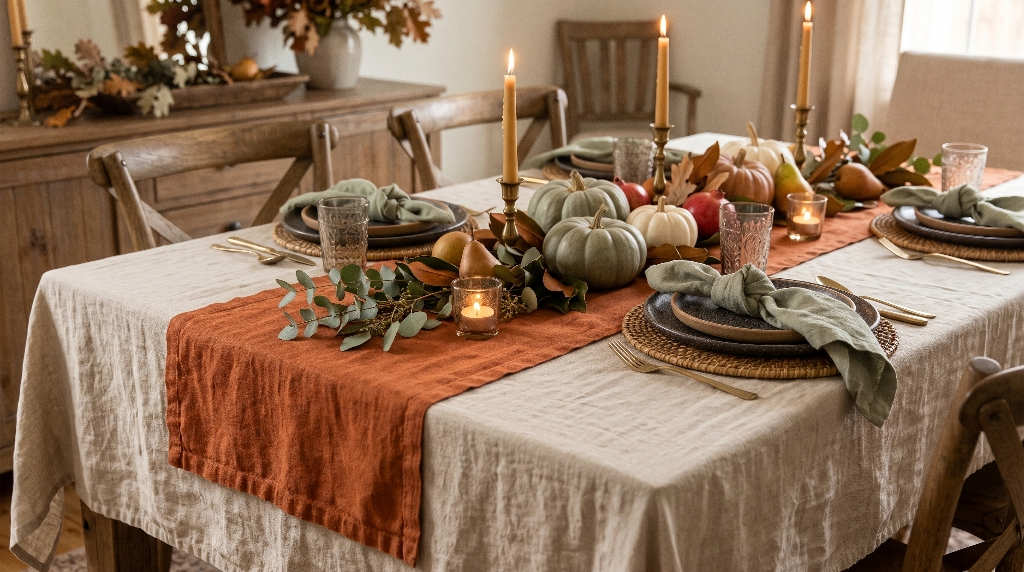
Once you know your exact measurements, you get to focus on color and texture. Because stonewashed linen absorbs natural dyes deeply into its softened fibers, the colors look rich, muted, and organic rather than flat or overly bright. Choosing the right shade sets the visual tone for the entire meal.
Earth-Toned Vintage Hues That Flatter Autumn Food and Candlelight
Thanksgiving dinner is already bursting with natural autumn color, from golden roasted turkey and orange sweet potatoes to deep ruby cranberry relish and green beans. Your table runner should act as a calm, flattering backdrop that makes that food look even more appetizing under warm evening candlelight.
Warm neutral shades of stonewashed linen, such as raw oatmeal, antique ivory, and sandy flax, brighten dark walnut or mahogany tables and reflect soft candle glow onto guests’ faces. If you have a lighter oak, maple, or pine dining table, deeper vintage tones create gorgeous contrast. Terracotta, cinnamon rust, warm ochre, and burnt sienna echo the colors of fallen autumn leaves without feeling like novelty holiday decor. Muted botanical shades like dusty sage green and slate blue also pair beautifully with vintage brass and white ceramic dishes, giving your table a timeless French country feel that works well beyond November.
Bare Wood vs. Layering Over a Full Linen Tablecloth
You have two distinct ways to build the foundation of your Thanksgiving table. The most popular approach is laying your vintage stonewashed linen runner directly onto a bare wooden table. This single-layer look feels relaxed, architectural, and honest. It lets the warmth of the wood grain shine through while the runner softens the hard surface and dampens the clatter of plates and silverware.
However, if your dining table has a glass top, a heavily scratched finish, or removable leaves that do not match in color, layering is your best friend. Start by draping a full-length, solid neutral tablecloth over the entire table, using crisp white, ivory, or soft dove gray. Then lay a darker or patterned vintage stonewashed linen runner right down the center on top of the base cloth. Layering two weights of linen adds luxurious depth, protects the tabletop underneath, and gives a formal dining room unmistakable designer polish.
Pairing Textures: Stoneware, Brass, Olive Wood, and Woven Chargers
Great interior design relies on mixing contrasting textures so the eye stays engaged. Because stonewashed linen has a soft, matte, slightly crinkled surface, it pairs best with materials that offer crisp edges, natural sheen, or rigid structure.
Start each place setting with a woven rattan, seagrass, or carved olive wood charger plate on the bare wood beside the runner. Top the charger with handmade stoneware dinner plates featuring speckled glazes or raw clay rims. Along the center strip of stonewashed linen, mix in vintage tarnished brass candlesticks, smoked glass votive holders, and matte ceramic bowls. Finish each setting with matching or tonal linen napkins tied loosely with twine or slipped through simple wooden napkin rings. When soft textiles meet warm metal, raw clay, and natural wood, the entire table feels rich and layered without needing clutter.
Centerpiece Sightlines and Functional Hosting Flow
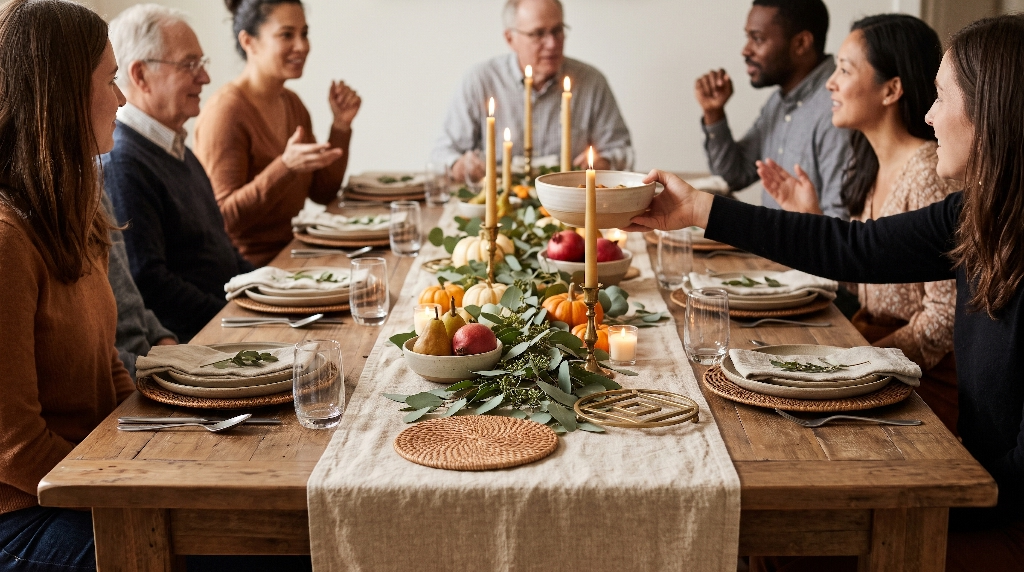
A stunning Thanksgiving table still has a job to do. Unlike a decorative side table in a foyer, your holiday dining table has to hold hot serving bowls, gravy boats, bread baskets, and wine bottles while allowing ten or twelve people to talk comfortably for hours. Smart planning keeps your stonewashed linen runner both gorgeous and practical.
Keeping Arrangements Below Eye Level for Effortless Conversation
The single most common mistake in holiday table styling is building a tall centerpiece that blocks guests from seeing one another across the table. Nobody wants to lean sideways around a giant vase of sunflowers just to talk to their cousin or grandmother.
Follow the classic dining room sightline rule: keep all centerpieces, candles, and greenery either low enough to look over or slender enough to see past. Low ceramic compote bowls filled with seasonal pears, pomegranates, figs, and trailing eucalyptus stay well below seated eye level, usually under 10 inches tall. When adding beeswax taper candles along your stonewashed linen runner, choose slender candlesticks that lift the flame above eye level without creating a solid visual wall. Staggering low bowls, mini heirloom pumpkins, and scattered votives down the length of the runner draws the eye smoothly from one end of the table to the other while keeping every seat connected.
Carving Out Landing Zones for Hot Trivets and Passing Platters
Before you light a single candle, walk through how food will actually move around your table. If you carve the turkey in the kitchen and pass platters family-style, you need open landing zones along the runner where hot dishes can rest safely.
Leave intentional gaps of 12 to 15 inches between your floral clusters or pumpkin groupings, and tuck flat cork, woven, or brass trivets right onto the stonewashed linen in those open spots. Although thick flax linen handles mild warmth well, placing a hot Dutch oven or roasting pan directly onto any fabric can scorch the fibers or transfer heat into the wood finish underneath. Planning those landing zones ahead of time means you will never have to frantically clear away candles and greenery while holding a heavy, steaming platter of mashed potatoes.
Real-Life Holiday Resilience: Removing Gravy, Wine, and Candle Wax
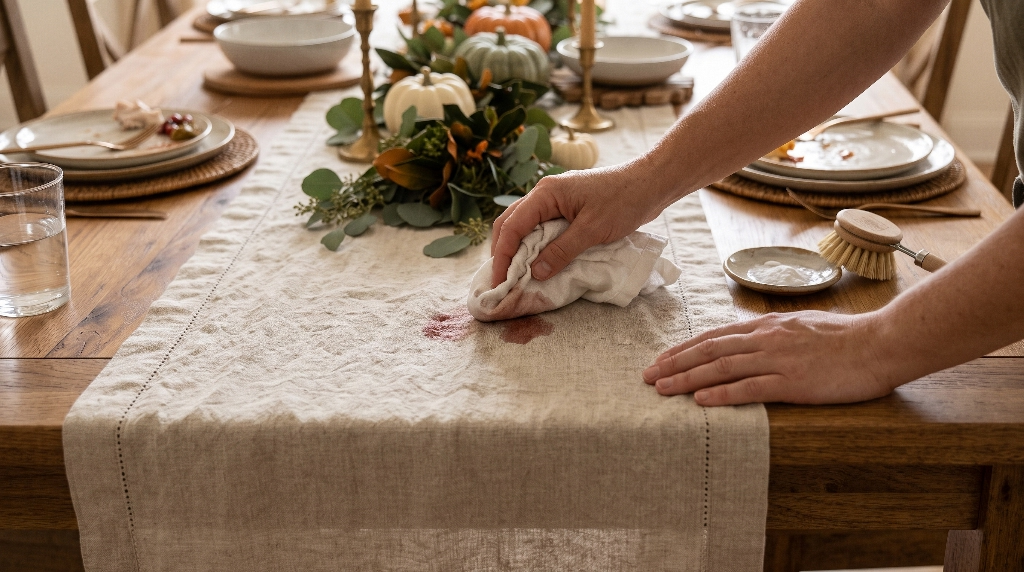
Many hosts hesitate to buy nice table linens because they worry one messy dinner will ruin their investment. In truth, genuine stonewashed linen is one of the most forgiving, durable fabrics you can put on a dining table. Flax fibers do not trap dirt deep inside synthetic threads the way polyester does, meaning almost every class
ic Thanksgiving spill comes right out when you treat it properly.
The First-Response Rule: Blot, Never Rub, and Avoid Early Heat
When a spill happens during dinner, your first thirty seconds matter most. Grab a clean cloth napkin or paper towel and blot the liquid gently from the outside of the spill toward the center. Never scrub or rub a fresh stain on stonewashed linen, because rubbing pushes pigment deeper into the flax weave and can fuzz the surface fibers.
Even more importantly, keep heat away from a stained runner until the spot is completely gone. Never put a stained piece of stonewashed linen into hot wash water or a warm clothes dryer. High heat cooks protein stains like turkey gravy and sets tannin stains like red wine permanently into the natural fibers. Always treat and rinse with cool or lukewarm water first, and inspect the fabric in bright daylight before drying.
Spot-Treating Thanksgiving’s Big Three: Turkey Gravy, Red Wine, and Dripped Wax
Knowing how to handle the three most common holiday spills takes all the stress out of hosting:
- Turkey Gravy and Butter (Grease and Protein): Gently lift away any solid bits with the edge of a butter knife or spoon. Cover the greasy spot with a generous sprinkle of baking soda or cornstarch for fifteen minutes to absorb the oil, then brush it off. Work a drop of clear liquid dish soap into the dampened stain with your fingertips, let it sit for ten minutes, and rinse thoroughly with cool water before washing.
- Red Wine and Cranberry Sauce (Tannins and Berry Pigment): Blot up as much liquid as possible right away. Stretch the stained section of stonewashed linen over a bowl, secure it with a rubber band, and pour cold water or club soda steadily through the fabric from above to flush out the pigment. For lingering purple shadows, soak the spot in cool water mixed with an oxygen-based stain remover for one to two hours before laundering.
- Dripped Beeswax or Taper Candle Wax: Resist the urge to wipe warm wax, which only smears it further into the weave. Instead, let the wax harden completely, or place a zip-top bag filled with ice cubes on top of the drip for five minutes until it turns brittle. Slide a dull butter knife under the hardened wax to pop off the bulk of it. Next, sandwich the remaining waxy spot between two clean brown paper bags or plain white paper towels and press gently with a warm, dry iron. As the wax melts, the paper absorbs it right out of the linen.
Washing and Drying Without Losing That Soft Stonewashed Texture
After dinner is over and spots are pre-treated, caring for stonewashed linen is remarkably easy. Wash your runner in your regular washing machine on a gentle cycle using cool or lukewarm water and a mild, liquid laundry detergent. Skip chlorine bleach, which weakens natural flax fibers and causes yellowing over time, and skip liquid fabric softeners, which leave a waxy coating that ruins linen’s natural absorbency.
Once the wash cycle finishes, take the runner out promptly, give it a firm snap with both hands to release tight creases, and hang it over a drying rack or clothesline. Air-drying preserves the organic, crinkled texture that gives stonewashed linen its signature vintage appeal. If you prefer to use a dryer, tumble on low heat for just ten minutes while the fabric is still slightly damp, then lay it flat on your dining table to finish air-drying smoothly.
Common Thanksgiving Stonewashed Linen Table Runner Questions
How long should a table runner be for a Thanksgiving table?
Add 12 to 24 inches to the total length of your dining table so the runner hangs 6 to 12 inches over each end. For a standard 72-inch (6-foot) table, choose an 84-inch to 90-inch stonewashed linen runner for balanced holiday drape that will not interfere with guests seated at the ends.
Should a table runner hang over the edge of the table?
Yes, a traditional Thanksgiving runner hangs 6 to 12 inches past each end to frame the table softly and showcase decorative borders like hemstitching or fringe. If you prefer a sleek, modern look, choose a shorter runner that sits centered on the tabletop at least 6 to 9 inches away from each edge.
How wide should a table runner be?
Select a table runner roughly one-third the width of your dining table, which is typically 12 to 15 inches wide for standard 36-inch to 42-inch tables. This proportion anchors your centerpiece while leaving at least 10 inches of clear wood tabletop on both sides for dinner plates, flatware, and glassware.
Can you use a table runner on a round Thanksgiving table?
Yes, lay a single runner straight across the center diameter of a round table, adding 12 to 24 inches to the table diameter so both ends drape evenly. On larger 60-inch round tables, you can also cross two stonewashed linen runners in an X-shape to anchor the center and define place settings.
Do you iron a stonewashed linen table runner?
No, you do not need to iron a stonewashed linen table runner because the fabric is specifically finished to showcase its relaxed, naturally crinkled texture. Simply shake the damp runner out after washing and let it air-dry flat, or press lightly with a steam iron only if you prefer crisp, formal edges.
Buying Checklist and Heirloom Storage Beyond November
Buying a well-made table runner is a small investment that pays off across dozens of holidays, birthdays, and Sunday dinners. Before you click order or bring a new piece home, run through a quick quality check to make sure you are getting authentic craftsmanship, and set up simple storage habits so your runner stays fresh year after year.
Five Quality Markers to Check Before Buying Online
When shopping online where you cannot touch the fabric in person, look closely at product descriptions and close-up photos for these five markers of true quality:
- 100 Percent European Flax Content: Check the fiber label carefully to confirm the runner is pure flax linen rather than a cotton-linen or polyester blend, and look for certifications like OEKO-TEX Standard 100 or European Flax to guarantee safe, non-toxic dyes.
- Listed GSM Weight: Choose sellers who openly share the fabric weight and aim for 180 to 220 GSM so your stonewashed linen runner has enough substance to lie flat without wrinkling into messy bunches.
- Pre-Washed Shrinkage Guarantee: Confirm the textile has already been stonewashed and pre-shrunk at the mill so the dimensions listed on the page match what you will have after your first wash at home.
- Tight, Even Seam Stitching: Zoom in on edge photos to verify that hems are stitched with dense, even thread tension and neat mitered corners, or that fringed edges are secured with a stay-stitch line so they do not unravel endlessly in the wash.
- Generous Length Options: Look for makers who offer multiple lengths in 6-inch or 12-inch increments so you can match your exact dining table measurement rather than settling for a one-size-fits-all strip.
How to Store Linen Runners Between Holidays Without Yellowing
Once Thanksgiving cleanup is finished, proper off-season storage keeps natural flax bright, fresh, and ready for the next gathering. Never store a table runner unless it is freshly laundered and completely bone-dry, because even tiny invisible traces of food sugar, cooking oil, or moisture can oxidize over months in the dark and leave stubborn yellow age spots.
Instead of folding your stonewashed linen runner into tight squares that create permanent crease lines, roll it smoothly around a clean cardboard wrapping-paper tube wrapped in acid-free tissue paper. Slip the rolled runner inside a breathable cotton pillowcase or linen storage bag and keep it on a shelf in a cool, dry, well-ventilated linen closet. Avoid storing natural linen inside sealed plastic bins or cardboard boxes in damp basements or hot attics, where trapped humidity can cause mildew and weaken fibers.
The very best part about choosing a vintage stonewashed linen table runner for Thanksgiving is that you do not actually have to pack it away when November ends. A warm oatmeal, terracotta, or sage runner transitions effortlessly into December when you swap out mini pumpkins for fresh cedar boughs, pinecones, and winter berries. Long after the holiday leftovers are gone, that same soft strip of linen stays right on your dining table for casual Sunday pot roasts, morning coffee with friends, and everyday family meals that turn a house into a true home.