


When we talk about building a home in the Tri-Cities, we often focus on the things we can see, like the granite countertops in a Johnson City kitchen or the stone siding on a house in Kingsport. However, as often talked about on this blog there is a lot to be concerned about the things you cannot see. The most important invisible factor is how air moves through your house. You might have the most beautiful home in East Tennessee, but if it is leaky, you will feel it in your wallet and in your bones.
To fix this, we use a special tool to measure the building. We are going to look at the science of the home and answer the big question: how does a blower door test work physics and all.
Video Version of this Article
The Invisible Enemy of Home Efficiency
Imagine you are sitting in your living room on a cold January night. You have the heat turned up, but you still feel a chill on your neck. You might think it is just the weather, but the truth is that your home is likely losing a battle against the air outside. In the home building industry, we call this air infiltration. It is the invisible enemy of every homeowner. Whether you are building a new custom home or trying to fix an old one, you have to understand how air moves.
A blower door is the most powerful tool we have to find these hidden problems. It is not enough to just guess where the drafts are coming from. We need to be precise. In my years as a project manager and general manager, I have learned that if you do not measure it, you cannot manage it. This article will explain the physics behind this test in simple terms. We will show you how we use pressure to find leaks and why this matters for your comfort and your energy bills. By the time we are done, you will see your home not just as a building, but as a system that needs to be sealed tight.
The Anatomy of the Test

Before we get into the math and science, let us look at the gear. A blower door is a machine that fits into the frame of one of your exterior doors. It has three main parts. First, there is a mounting frame and a flexible colorful sheet. This sheet blocks the rest of the doorway so no air can get through except through the machine. Second, there is a large, powerful calibrated fan. This fan is designed to move a very specific amount of air.
The third and most important part is the manometer. Think of the manometer as the brain of the machine. It is a digital gauge that measures two things at the same time. It measures the air pressure inside your house compared to the air pressure outside. It also measures how much air is moving through the fan.
To get ready for the test, we have to prep the house. We go through and close all the windows and outside doors. We open all the interior doors so the air can flow freely between rooms. We also have to be very careful with “combustion appliances.” These are things like your gas water heater or your fireplace. If we don’t turn them off or “safe” them, the blower door might suck smoke or carbon monoxide back into the house. That is a safety risk we never take. Once everything is set, we turn on the fan.
How Does a Blower Door Test Work? (The Physics)
Now, let us talk about the physics. The main idea here is “pressure differential.” In nature, air always wants to move from an area of high pressure to an area of low pressure. If you blow up a balloon, the air inside is at high pressure. When you let go of the end, the air rushes out to the lower pressure air in the room. Your house works the same way.
When we use a blower door, we usually perform what is called “depressurization.” The fan sucks air out of the house. This lowers the air pressure inside. Because the pressure outside is now higher than the pressure inside, the outside air tries to force its way into the house through every crack, hole, and gap it can find. This is how we find the leaks.
We use a standard pressure of 50 Pascals for the test. A Pascal is a very small unit of pressure. To give you an idea of how much pressure 50 Pascals is, it is about the same as a 20 mile per hour wind blowing against your house from every single direction at once. By creating this specific pressure, we can get a steady reading that we can compare to other houses.
This is all based on fluid dynamics. Air is a fluid, just like water. It flows through the building envelope, which is the “skin” of your house. If the skin has holes, the fluid will move through them. By measuring how hard the fan has to work to keep the house at 50 Pascals, we can calculate exactly how big those holes are if we added them all up into one giant gap.
To reach our goal of being very thorough, let us talk more about the fan. The blower door fan is not like a regular box fan you buy at the store. It is a precision instrument. It has sensors that measure how much air is passing through it.13 If the house is very tight, we have to put “rings” on the fan to make the opening smaller. This allows the fan to still give an accurate reading even when it only needs to move a little bit of air.
When we talk about the pressure of 50 Pascals, we are talking about a very steady pressure. If it is a windy day in East Tennessee, the wind can push against the house and mess up the reading. To fix this, the manometer uses a long tube that goes outside. It compares the indoor pressure to the average outdoor pressure to make sure the wind does not give us a wrong answer. This is why the engineering behind the blower door is so impressive.
Measuring the Results (The Math of Air Leakage)

Once the fan is running and the pressure is steady at 50 Pascals, the manometer gives us some numbers. The first number is CFM50. This stands for Cubic Feet per Minute at 50 Pascals. It tells us how many cubes of air (one foot by one foot by one foot) are leaving the house every minute.
However, CFM50 does not tell the whole story. A big house will naturally have a higher CFM50 than a small house because it has more space. To make it fair, we use a number called ACH50. This stands for Air Changes per Hour. This number tells us how many times every single bit of air inside your house is replaced by outside air in one hour during the test.
I like to use the “Lungs” analogy. Your house needs to breathe a little bit so the air stays fresh. But if it breathes too much, it is like running a marathon all day long. It wastes energy and makes the HVAC system work too hard. If the ACH50 is too high, your house is too leaky. If it is very low, the house is “tight.” A tight house is great for energy bills, but we have to make sure there is enough fresh air for the people inside to breathe safely.
Why the Physics Matter for Tri-Cities Homeowners
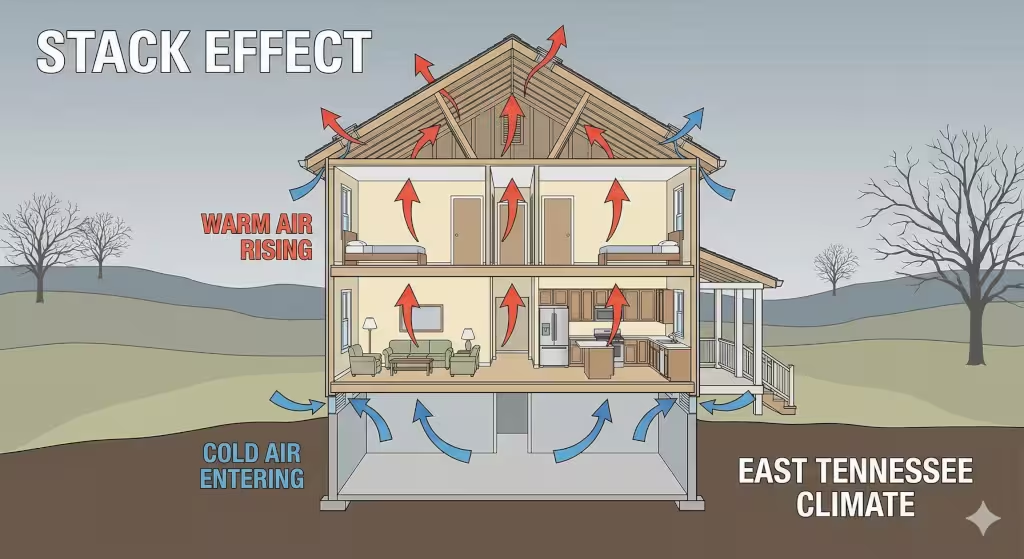
Living in the Tri-Cities area, we have a unique climate. We get hot, humid summers and cold, biting winters. The physics of air movement is very important here. One major factor is the “Stack Effect.” Think about a chimney. Hot air rises. In the winter, the warm air in your house rises to the top and escapes through holes in your attic.10 As that air leaves, it creates a vacuum at the bottom of the house. This vacuum sucks cold air in through your crawlspace or basement.
This means you are losing money at the top and the bottom of your house at the same time. A blower door helps us see exactly how much the stack effect is hurting you. In Tennessee, there are also laws and building codes that require new homes to meet certain energy standards. As a builder, I have to make sure every home I oversee passes these tests. It is not just about following the law; it is about making sure the family living there is comfortable. If a house is not sealed well, the humidity in our area can get inside the walls and cause mold or rot. That is why getting the physics right is a matter of integrity.
Your Answered about Blower Door Tests
Many people ask me, “How long does a blower door test take?” Usually, it takes about one to two hours. Most of that time is spent setting up the frame and checking the house for safety. The actual test where the fan is running only takes a few minutes.
Another common question is, “Can a house be too tight?” The answer is yes and no. A house can be so tight that moisture and stale air get trapped inside. However, we have a saying in the industry: “Seal tight, ventilate right.” We want the house to be as tight as possible to save energy, but then we add mechanical ventilation. These are machines like an ERV or HRV that bring in fresh air in a controlled way.11 This is much better than letting air leak in through a dirty crawlspace.
What is a good score in east Tennessee? In our area, the code might require a score of 5 ACH50 or lower. But a high-performance custom home might aim for a 1 or even lower. The lower the number, the better the seal. To find the actual leaks while the fan is running, we often use a thermal camera. The camera shows us where the cold air is rushing in, appearing as purple or blue streaks on the screen.
Considerations in Blower Door Tests
When we do this work, we follow rules set by groups like BPI (Building Performance Institute) and RESNET. These groups train people to be HERS Raters. A HERS Rater is like a judge for a home’s energy use. They use the blower door to give the house a score.
We also look at things like “thermal bridging.” This is when heat moves through the solid parts of your house, like the wooden studs in your walls. Even if your air seal is perfect, you can still lose heat if you don’t have good insulation. We also check “duct leakage.” Sometimes the blower door shows the house is tight, but the air ducts for the heater are full of holes. All of these things work together to create the “Building Envelope.” If one part fails, the whole system suffers. Understanding the kinetic energy of air and how it moves helps us build better homes.
The Value Add: What to Do With the Data
So, what do we do once we have the blower door results? We use the data to prioritize repairs. Builders know that you get the most bang for your buck by sealing the “top” and the “bottom” of the house first. This means sealing the holes in your attic floor and the gaps in your rim joists in the basement or crawlspace.
By fixing these leaks, you improve your indoor air quality. You stop dust, pollen, and even pests from being sucked into your living space. You also save money. When your home is sealed, your HVAC system does not have to run as often. It can be smaller and last longer. In the 423 area code, where we live, this can save a homeowner hundreds of dollars every year. It is one of the smartest investments you can make in your property.
Precision Leads to Performance
Using a blower door is about more than just science. It is about being a competent and precise builder. It shows that we have the integrity to check our work and make sure it is done right.
Precision in testing leads to performance in the home. You wouldn’t buy a car without knowing its gas mileage, so why would you buy or live in a home without knowing how much air it leaks? Understanding how does a blower door test work physics and all is the first step toward a better home. It gives you the power to make your house more comfortable, more efficient, and more durable for years to come. You simply cannot manage what you do not measure.
Additional Things to Consider
The Human Element of Air Sealing
While the physics are important, we also have to think about the people. A leaky house is not just expensive; it is uncomfortable.14 Have you ever felt a “draft” that felt like someone left a window open? Often, that is not a window at all. It is air being pulled through an electrical outlet or a light fixture in the ceiling.
When we use the blower door, we can actually show the homeowner where these leaks are. I have had clients put their hand near a light switch while the fan was running and their eyes go wide. They can feel the cold air rushing in. This makes the science real for them. It is no longer just a number on a screen; it is a physical feeling. This is why the blower door is such a great teaching tool. It helps people understand that their home is a living, breathing thing.
Why Ductwork Matters Too
Sometimes, we perform a second test called a “Duct Blaster” test along with the blower door. While the blower door checks the whole house, the duct blaster checks only the tubes that carry your air. If your ducts are in an unheated attic and they have leaks, you are paying to heat the squirrels and birds outside.
When we combine the blower door with a duct test, we get a complete picture of the home’s energy health. In the Tri-Cities, many older homes have ducts that were never sealed with “mastic” (a sticky gray paste). Over time, the old duct tape dries out and falls off, leaving big gaps. The blower door can sometimes pull air through these gaps, showing us that the HVAC system is part of the problem.
The Role of the Building Envelope
The building envelope is like a coat for your house. If you go outside in the winter with a heavy wool coat but you leave it unzipped, you will stay cold. The insulation in your walls is like the wool, but the air seal is like the zipper. If you don’t zip the coat, the wind goes right through the wool.
A blower door tells us how well “zipped up” your house is.15 If the zipper is broken, we find the spots where it is failing. This is why new construction is so different today than it was thirty years ago. We now focus on the “air barrier.” This is usually a layer of house wrap or special tape on the outside of the plywood. By making this layer continuous, we make the blower door’s job much harder, which is exactly what we want.
Modern Technology and Generative Insights
In today’s world, we also use computers to model how a house will perform before we even dig the foundation. We can predict what the blower door score will be based on the materials we use. This is part of being a modern builder. We use these “Generative” tools to design homes that are optimized for our specific weather.
When the house is finished, the blower door test is the final exam. It proves that the computer model was right. It gives the homeowner peace of mind that they got what they paid for. It is the bridge between the design and the reality of the building.
Conclusion and Next Steps
I hope this examination into the physics of air movement has been helpful. Whether you are building in Kingsport, Bristol, or Johnson City, knowing how your home handles air is key to your happiness as a homeowner. We use tools like the blower door because we want to be certain, not just hopeful.


